Zhao Zhiqian (1829–1884)
Zhao Zhiqian, courtesy name Yifu, later changed to Huishu, and pseudonyms Lengjun, Mei'an, and Tiesan, was from Kuaiji (present-day Shaoxing), Zhejiang. He was a pioneer painter of the "Haipai" (Shanghai School) and achieved great success in painting, calligraphy, and seal carving, founding his own artistic style. He integrated seal and clerical script techniques into his painting, creating works that were simple, vigorous, and full of ancient charm, becoming a trailblazer in incorporating epigraphic elements into painting.
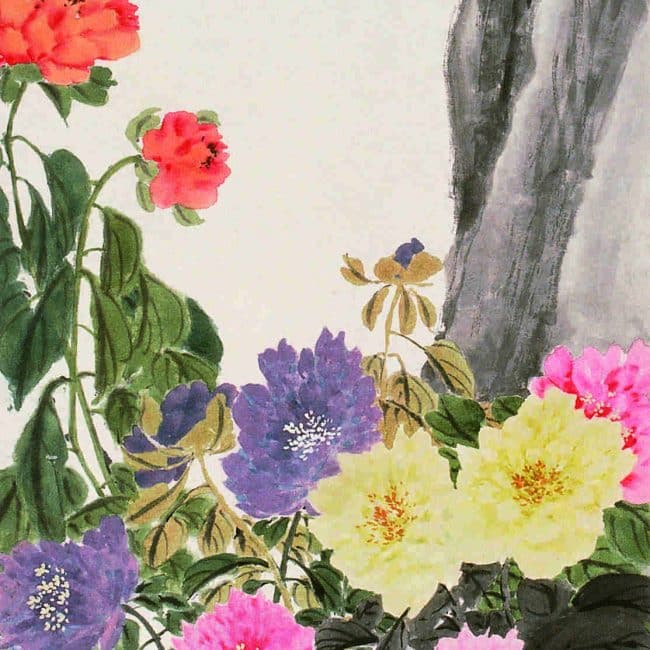
"Peony" (1868)
This painting, created in 1868, features fluid and vibrant brushwork with rich colors that are not garish. Zhao Zhiqian skillfully blended the strengths of Xu Wei and Bada Shanren with the brushwork of epigraphic calligraphy, creating a work of great power and grandeur, unique in style, and one of his masterpieces. The inscription reads: "During the Tang and Yu dynasties, Dongting contributed tribute, and the poem 'Chenzi' first appeared in the 'Classic of Poetry.' Please harmonize the ancient meaning. Painted by Zhao Zhiqian for Elder Brother Chunqing in the seventh month of the Wuchen year of Tongzhi, while staying in the capital." The seal reads "Zhao Zhiqian's seal."
Yang Xian (1819–1896)
Yang Xian, courtesy name Jianshan, pseudonym Yongzhai, and later known as Miaoweng and Chihong Cansou, was from Guian (present-day Huzhou), Zhejiang. He passed the imperial examination in the fifth year of Xianfeng (1855) but failed the metropolitan examination. He later joined the staffs of Zeng Guofan and Li Hongzhang, assisting in military affairs, and rose to the position of Salt Transport Commissioner and prefect of Songjiang. After offending his superiors and being dismissed, he settled in Suzhou, where he devoted himself to reading and writing, making a living by selling calligraphy.
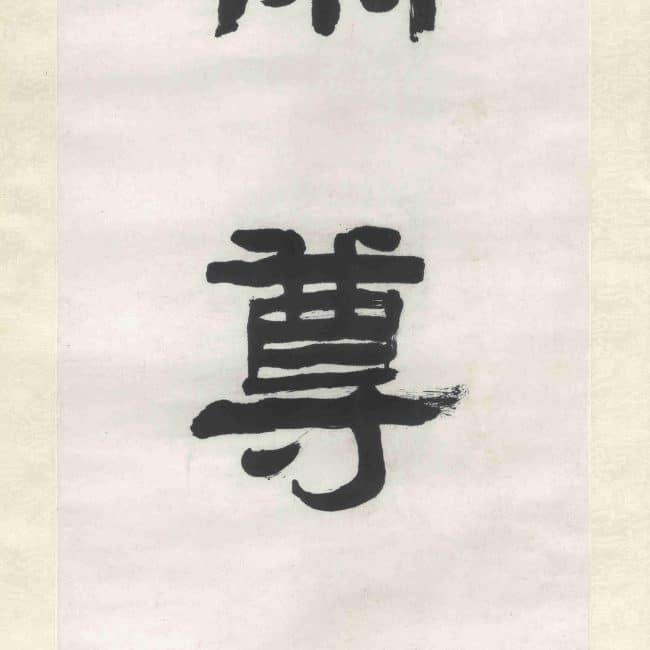
Yang Xian's calligraphy was especially strong in clerical script, drawing extensively from Han steles with a broad approach. This made his brushwork highly skilled. In the structure of his characters, he broke away from the convention of the square, compact forms of Han steles, opting instead for a tighter top and looser bottom. Combined with the extended left and right strokes and a flying, dynamic execution, he developed his own sharp, lively, and floating style. His clerical script was most distinctive during the Xianfeng and Tongzhi periods, earning great acclaim at the time.
Translation of couplet:
"The mountain rain and the respected old man remain; The pavilion and fragrant grass are extraordinary."
Zhao Ziyong (1786–1847)
Zhao Ziyong, courtesy name Mingshan and pseudonym Mingshan, was from Nanhai, Guangdong. He passed the imperial examination in the 21st year of Jiaqing (1816) and served as magistrate of Weixian County and prefect of Qingzhou, Shandong, where he was known for his good governance. After being dismissed from office, he made a living by selling paintings. An accomplished writer and horseman, Zhao Ziyong was particularly skilled in painting bamboo, capturing the spirit of Zheng Banqiao with either snow-laden or frost-covered bamboo, as well as slender and delicate shoots, all rendered with lifelike vitality.
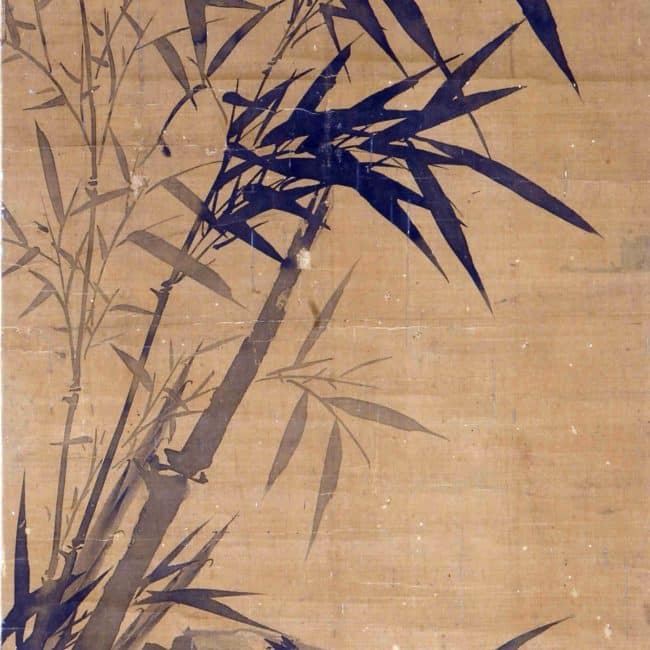
"Bamboo and Rocks"
This painting depicts wind-swept bamboo beside a rock, with leaves rendered in varying shades of ink, swaying gracefully in the breeze. The lines of the rocks are strong and vigorous, conveying a sense of serene elegance. The inscription reads: "For the appreciation of Mr. Lanshi, by Zhao Ziyong." The seals read "Zhao Ziyong's seal" and "Mingshan."
Tang Yifen (1778–1853)
Tang Yifen, courtesy names Yusheng and Ruoyi, and pseudonyms Zhou Weng and Qinyin Daoren, was from Wujin (present-day Changzhou), Jiangsu. He rose to the position of Deputy General of Wenzhou and, citing illness, retired to Nanjing, where he built the Qinyin Garden. Tang Yifen had a wide range of interests and exceptional talent in various fields such as astronomy, geography, and the teachings of ancient philosophers. He was also proficient in poetry, calligraphy, and painting, and had a keen interest in music, horsemanship, and fencing. He was particularly renowned for his painting. In 1853, during the Taiping Rebellion's attack on Nanjing, Tang Yifen assisted the Governor of Liangjiang, Lu Jianying, in defending the city. After their defeat, he calmly composed a final poem and drowned himself, earning the posthumous title "Zhenmin."
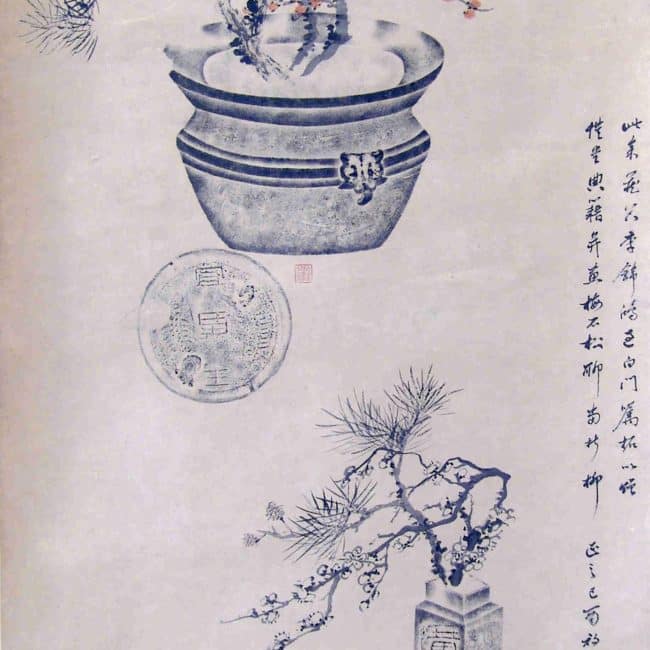
"Han Style Repaired Painting" (1849)
This painting by Tang Yifen on a full-shape rubbing of bronzes represents a new painting style that became popular in the late Qing and Republican periods. Full-shape rubbing, also known as "three-dimensional rubbing," is a special technique that transfers the original appearance of an object onto flat rubbing paper, requiring great skill. The three bronze items in the painting are carefully arranged, with the ink wash of the pine, plum, and background stones applied lightly, harmonizing with the rubbing and creating a sense of ancient charm. The only color used is the light red of the plum blossoms, which serves as a focal point to avoid monotony. This work showcases the artist's ingenuity. The inscription reads: "These are items from my collection. Li Jinhong passed by Baimen and asked me to make rubbings as a gift for Kaitang's library, and I painted plums, stones, and pines to complement them. Early winter of the Jiyou year, inscribed by Yifen while ill." The seals read "Tang Yifen's seal" and "Li Jinhong of Yanghu personally made this rubbing." The collector's seal reads "Once in the collection of Liu's Jingxiutang of Jingjiang."
Wang Su (1794–1877)
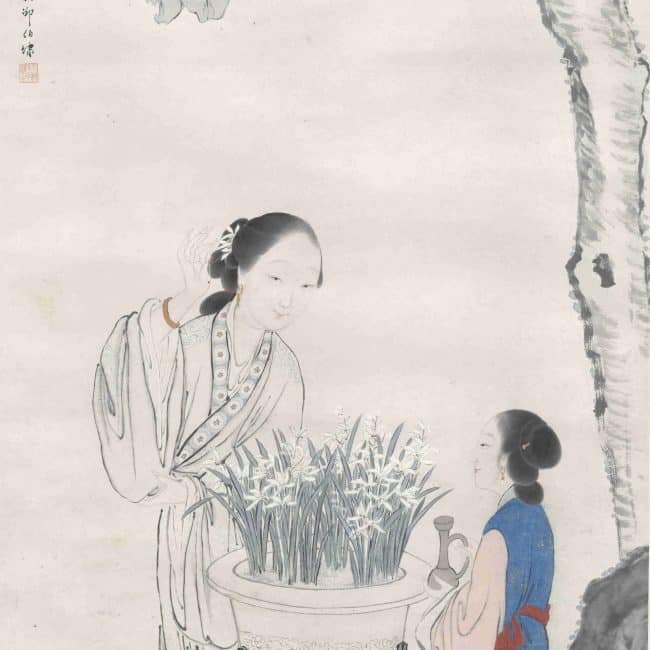
Wang Su, courtesy name Xiaomei and later known as Xunzhi, was from Ganquan (present-day Yangzhou), Jiangsu. He was an important painter in the 19th-century Yangzhou art scene. From a young age, he studied painting and followed the style of Hua Yan, capturing its essence. He was skilled in various subjects, including figures, flowers, birds, animals, and fish, but his main achievements were in figure and ladies' paintings. Despite lamenting his clumsy calligraphy, he practiced hundreds of characters every morning without fail, even into old age. His seal carving followed the style of Han dynasty seals and was quite remarkable, though often overshadowed by his fame as a painter.
"Orchid and Rock"
In this painting, the background elements such as rocks, bamboo, and parasol trees are rendered in a small freehand style, while the central figures of the ladies, the flower stand, and the orchids are more meticulously executed, creating a contrast. The two ladies are elegantly posed, and the lines of their clothing reflect the expressive style of Huang Shen and Min Zhen. The varying ink tones are rich and natural, with a rhythmic quality. The overall composition is elegant and refined, with the figures exuding a sense of beauty and scholarly charm. The inscription reads: "Orchids and Rock. Painted by Xiaomei Wang Su in Shaobo Embankment, six days before the Flower Morning of the Yimao year." The seal reads "Xiaomei also known as Xunzhi."
Ren Yi (1840–1896)
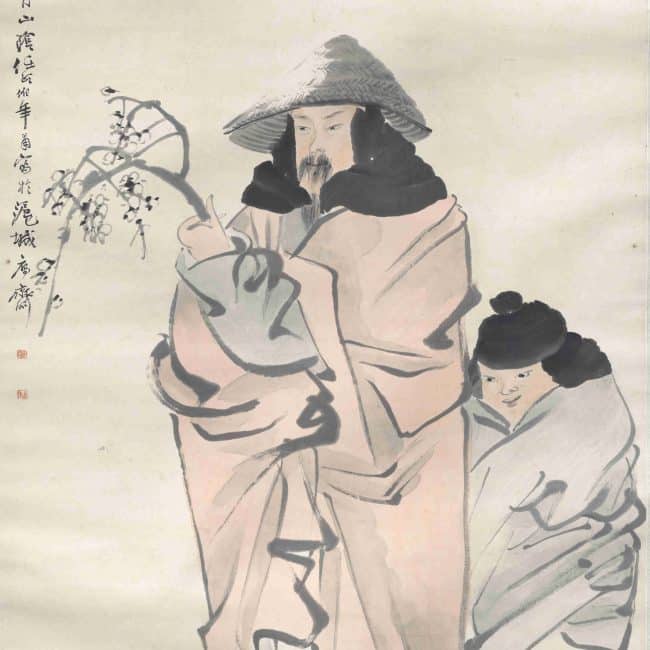
Ren Yi, courtesy name Boren, pseudonym Xiaolou, was from Shaoxing, Zhejiang. He learned portrait painting from his father in his youth and later studied painting under Ren Xiong and Ren Xun. He lived in Shanghai, making a living by selling paintings. His techniques were comprehensive, encompassing landscapes, flowers, birds, and figures. Ren Yi inherited the rustic charm of folk painting, incorporating the styles of Chen Hongshou, Chen Chun, Xu Wei, Yun Shouping, Hua Yan, Ren Xiong, and Ren Xun, and absorbed Western sketching and coloring techniques, forming a unique style characterized by simplicity, clarity, and vividness. His work had widespread appeal and a distinct contemporary flavor. Together with Ren Xiong, Ren Xun, and Ren Yu, he was known as one of the "Four Rens of Shanghai," significantly influencing later painting.
"Seeking Plum Blossoms in the Snow" (1889)
This painting, created in 1889 when Ren Yi was fifty years old, is a late work. The brushwork is simple and the lines are strong and fluid, with a touch of roughness, making it a rare example among his figure paintings. The elderly man depicted wears a bamboo hat, holds a plum branch, and has a joyful expression, allowing the viewer to experience the pure and fragrant world of plum blossoms in the snow, making it highly captivating. The inscription reads: "In the Jia Ping month of the Jichou year of Guangxu, painted by Ren Yi Boren in his studio in Shanghai." The seals read "Ren Yi's seal" and "Boren," with the seal "Yiyi Caotang" at the lower right. The collector's seal "Once in the collection of Liu Guojun" is affixed at the lower left.
Tang Ken (1876–1950)
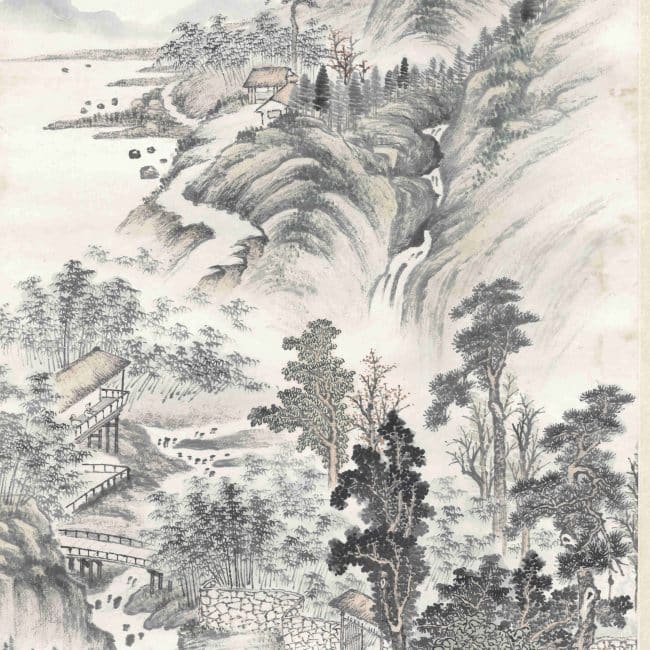
Tang Ken, courtesy name Qilin, a descendant of Tang Jinchuan, was from Wujin (present-day Changzhou), Jiangsu. In 1905, he studied law at Chuo University in Japan. After the founding of the Republic of China, he held various military and political positions in Zhili, including acting magistrate of Yixing County. After the Anti-Japanese War, he retired to Shanghai, refusing to accept puppet government positions and made a living through his art. He was skilled in literature, poetry, calligraphy, and painting, with a deep understanding of art appraisal and a vast collection, earning great acclaim.
"Pure Enjoyment in Bamboo Grove"
Tang Ken's landscape scroll, created for Mr. Liu Guojun, depicts scenes of ancient trees, bamboo groves, waterfalls, and mountain peaks, not only showcasing the grandeur of landscapes but also conveying a sense of leisurely seclusion in the mountains. His brushwork is powerful and elegant, reflecting his deep mastery of ancient techniques and a keen focus on capturing the spirit of nature to express his personal sentiments. The inscription reads: "Clear charm in a bamboo grove, for the appreciation of Brother Guojun, summer of the Guiwei year, by Tang Ken." The seals read "Tang Ken's private seal" and "Master of Xiaoban Garden."
Wu Daiqiu (1878–1949), Fan Shaoyun (1885–1962), Zhang Xuan (1898–1959)
Wu Daiqiu, named Zheng, courtesy name Daiqiu, and pseudonyms Baoxuan Jushi and Shulin Zhongzi, was from Chongde, Zhejiang. Son of the famous painter Wu Botao, he inherited the family tradition in painting and later studied under Wu Changshuo, excelling in landscapes and flowers, and birds. Together with Wu Hufan, Wu Zishen, and Feng Chaoran, they were known as the "Three Wus and One Feng."
Fan Shaoyun, named Haolin, courtesy name Shaoyun, was from Chongming, Shanghai. He specialized in landscape painting, diligently studying ancient and modern masterpieces, mastering both form and spirit. He later studied under the famous painter Lu Hui, further advancing his skills. Fan was also accomplished in playing the pipa and made significant contributions to traditional Chinese music. After the founding of the People's Republic of China, he served as a painter at the Shanghai Chinese Painting Academy and a member of the Shanghai branch of the Chinese Artists Association.
Zhang Xuan, courtesy name Kehe, pseudonym Mashi Weng, and alternative pseudonym Shiyuan Jushi, was from Wujin (present-day Changzhou), Jiangsu. A renowned painter and connoisseur in Shanghai, he excelled in landscape painting, with a deep foundation in traditional techniques, closely imitating the style of Wang Shigu. His brushwork was both vigorous and elegant, adept in both ink and color.
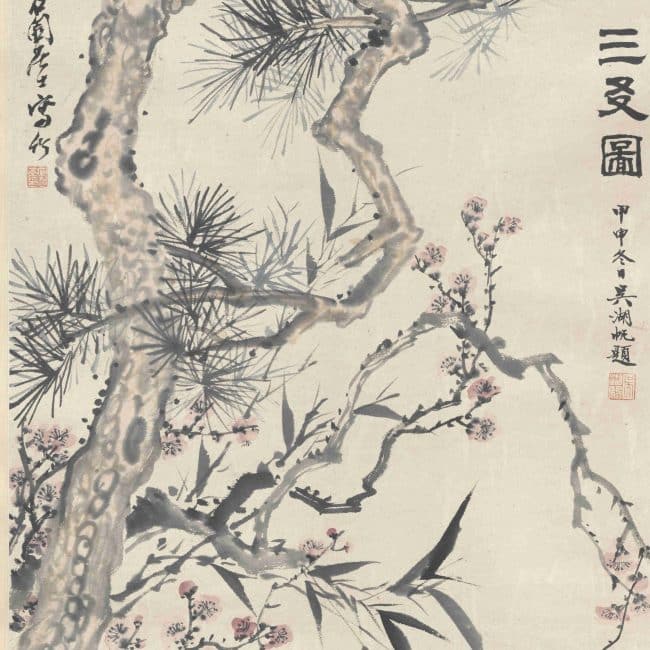
"Collaborative Painting of Three Friends"
This collaborative painting features the works of modern masters. On the right, Wu Hufan inscribed the title and signed: "Three Friends Painting, inscribed by Wu Hufan on a winter day of the Jia Shen year." The seals read "Wu Hufan." In the painting, Fan Shaoyun depicted the pine tree, ancient and rugged; Zhang Xuan painted the slender bamboo, elegant in posture; and Wu Daiqiu painted the red plum, exuding a cold fragrance. Although created separately, the composition is harmonious, exuding a strong literati atmosphere.
Huang Shanshou (1855–1919)
Huang Shanshou, originally named Yao, courtesy names Xuchu and Xuchu, and pseudonyms Lisheng, Xu Daoren, and Huxi Waishi, was from Wujin (present-day Changzhou), Jiangsu. He excelled in painting figures, landscapes, flowers, and animals, especially in ink dragons. For figures, he favored meticulous brushwork and vibrant colors, influenced by Gai Qi and Fei Danxu. His landscapes were renowned for their rich and elegant coloring. His flower and bird paintings skillfully combined the Wujin school's boneless technique with the traditional double-outline method. In his early years, he made a living as a private tutor, and after 1901, he moved to Shanghai, becoming a prominent artist of the Shanghai School.
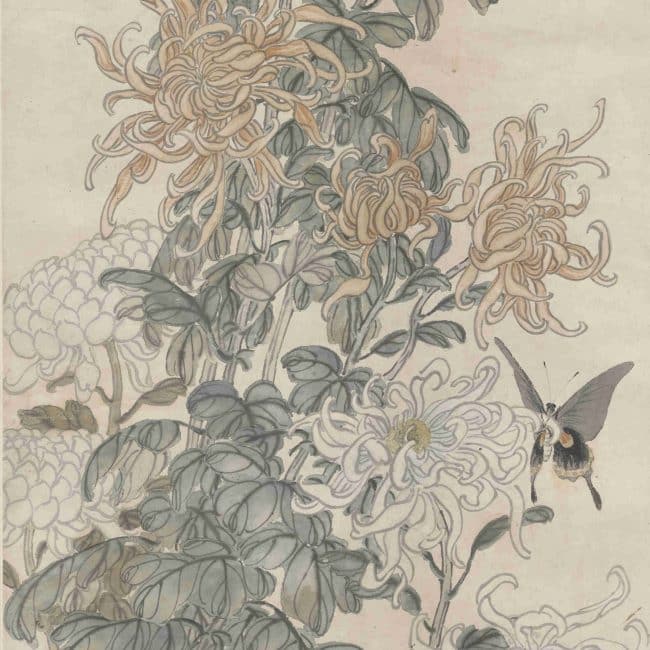
"Five Color Chrysanthemums"
Huang Shanshou's floral paintings were grounded in Yun Shouping's boneless technique but innovatively combined the double-outline method and Western painting techniques. This painting showcases his rich and vibrant coloring and elegant composition, vividly depicting the scene of blooming chrysanthemums. His inscriptions and calligraphy, influenced by Yun Shouping and Zhao Mengfu, seamlessly integrate with his paintings, exuding a refined and elegant style. The inscription reads: "The chrysanthemums bloom in five colors by the fence, resembling a brocade screen. The dazzling colors leave me in awe, do not mock the butterflies' wandering intentions among the flowers. By Xu Huang Shanshou." The seals read "Huang Shanshou" and "Master of Caijing Pavilion."
Bai Jiao (1907–1969)
Originally surnamed He, named Fazhi, also known as Fu, with the courtesy name Yuanxiang and the pseudonym Xuru, Bai Jiao was from Jinshan, Shanghai. He excelled in poetry, painting, and seal carving. His poetry was renowned in Jiangzuo, and his prose closely followed the Tang and Song styles. His calligraphy, rooted in the "Two Wangs," also drew from Ouyang Xun and Yu Shinan, making him a prominent figure in twentieth-century calligraphy. He was known for his ancient and elegant orchid paintings, which he rarely created for others.
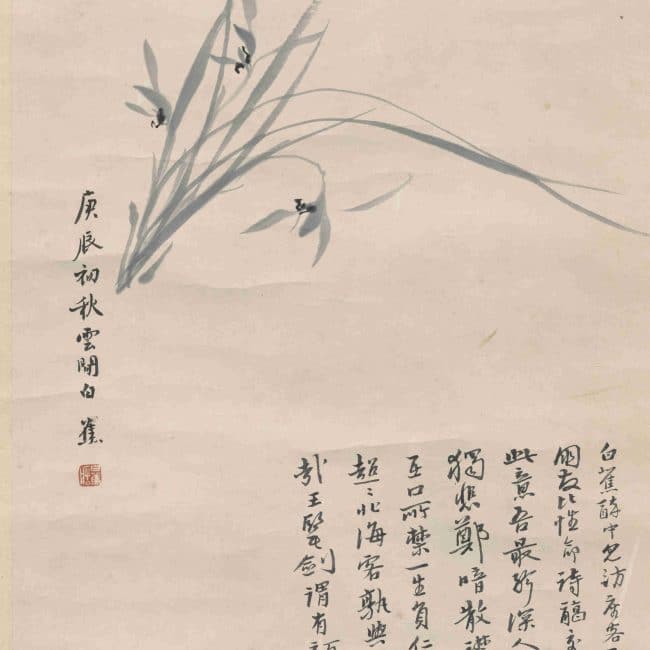
"Orchid"
Bai Jiao's orchid paintings drew from the strengths of ancient masters, emphasizing both natural inspiration and deep skill. His profound foundation in calligraphy lent precision and elegance to his paintings, imbued with scholarly charm and perfectly capturing the noble and otherworldly essence of orchids. His orchid paintings, along with Shen Shijia's bamboo and Gao Yihou's plum, were known as the "Three Wonders of Shanghai." This work, although composed of a few strokes, displays superior brushwork and an extremely pure and refined aura. The long poem inscribed by his friend, the painter and calligrapher Chen Dingshan, adds significant value.