Wu Wei (1459–1508)
Wu Wei, courtesy names Shiying and Ciweng, and pseudonyms Lufu and Xiaoxian, was a native of Jiangxia (modern-day Wuhan, Hubei). He was a prominent figure of the Zhe School following Dai Jin, renowned for his mastery of figure and landscape painting. Wu’s early painting style was meticulous and refined, but in his middle years, it evolved into a more vigorous and unrestrained approach, characterized by bold and sweeping brushwork. He is revered as the founder of the "Jiangxia School," which gained significant recognition in later generations.
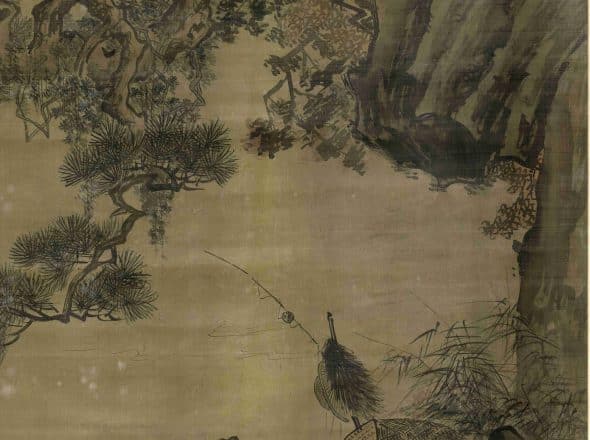
"Fishing Boats Moored at Dusk"
This painting depicts an elderly fisherman resting in a small boat under the pale light of the moon reflected in the water, evoking a serene and tranquil mood. The brushwork is bold and skillful, with vivid and lifelike rendering of the figure’s expression and posture. The piece bears Wu Wei's signature "Xiaoxian Hua" ("Painted by Xiaoxian") and is stamped with the white seal "Wu Wei."
Qian Weicheng (1720–1772)
Qian Weicheng, originally named Xinlai, with the courtesy name Zongpan and the alternate name Jiaxuan, later adopted the pseudonym Chashan. He was a native of Changzhou, Jiangsu. In 1745, during the 10th year of the Qianlong reign, he achieved the highest rank of zhuangyuan (top scholar) in the imperial examination. By 1748, he was appointed to the Southern Study, serving as a close aide to the emperor. A gifted poet, calligrapher, and painter, Qian's artistic style appealed to the emperor's tastes, earning him the title of "court painter-official." These scholar-officials not only excelled in administrative capabilities but also fulfilled the emperor’s cultural and artistic needs. Qian later held prominent positions such as Vice Minister of Works, Vice Minister of Justice, and various academic posts, where he achieved distinction in legal reforms and the handling of examination fraud cases. In 1772, during the 37th year of the Qianlong reign, Qian died at home at the age of 53 while mourning his father. He was posthumously honored with the title "Wenmin," a rare and prestigious recognition also granted to renowned masters Zhao Mengfu and Dong Qichang.
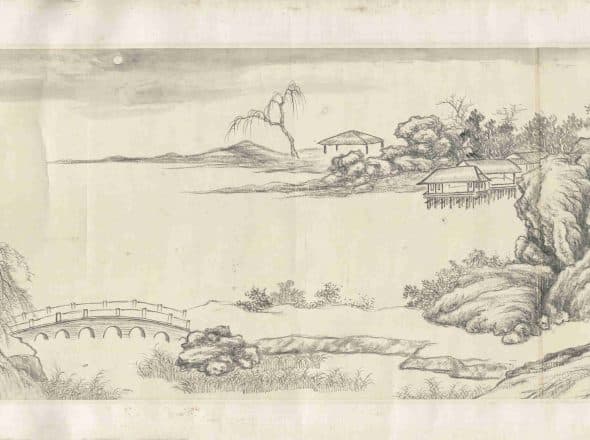
"Early Autumn in the Lake Mountains"
This painting portrays a tranquil and sparsely elegant landscape, embodying the poetic charm and spiritual resonance of Wang Yuanqi and Dong Bangda. The painting is noted for its refined composition and serene aesthetic. It bears the Qianlong Emperor's collection seal and inscriptions, indicating its inclusion in The Precious Collection of the Stone Moat Pavilion and its origins as an imperial collection. The inscription reads: "Respectfully painted by the subject Qian Weicheng," with two accompanying seals: a white seal "Subject Qian Weicheng" and a red seal "Respectful Service."
"Wang Qian (Dates Unknown, Possibly 1864–1935)
Wang Qian, courtesy name Yishou and pseudonym Tiannan Youzi, was a native of Xiaoshan, Zhejiang. Skilled in various artistic disciplines, he was particularly renowned for figure painting. In 1902, during the 28th year of the Guangxu reign, he published A Grand View of the Six Principles. After the Xinhai Revolution, Wang settled in Shanghai, becoming a prominent figure of the Shanghai School (Haipai). His figure paintings were inspired by Ren Xiong and influenced by the bold strokes of Min Zhen from the Eight Eccentrics of Yangzhou, forming his distinct personal style.
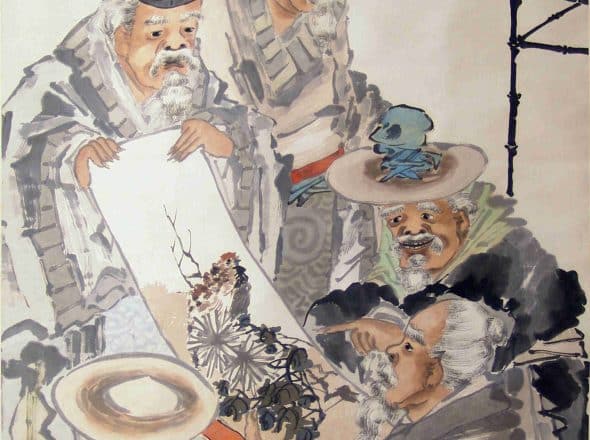
""The Five Elders Appreciating Paintings""
This painting depicts five elderly gentlemen engrossed in viewing a painting, showcasing characters of antiquity and eccentricity. Wang’s brushwork is bold and fluid, with a richness and vigor that fully embodies his artistic mastery. The faces incorporate Western chiaroscuro techniques, creating a sense of dimensionality. Each figure displays distinct expressions and postures, resulting in a lively and engaging composition. This work highlights Wang Qian's remarkable ability to blend Eastern and Western techniques seamlessly."
Lu Hui (1851–1920)
Lu Hui, originally named Youkui and later known as Youhui, was a native of Tongli, Wujiang, Jiangsu (now Wujiang District, Suzhou). He was also known by the courtesy name Lianfu and pseudonyms Jiansou, Jian’an, Jingnan Jiuke, Pofu Anzhu, and Rongxi Xuanzhu, among others. As a child, he pursued traditional studies and excelled in his entrance exams as a scholar. However, his path to official titles was blocked after accusations that his father had been involved with the Taiping Army. Lu turned to art under the guidance of Liu Delu, studying flowers, fruits, and feathers, earning acclaim for his orchid paintings. Later, he met Wu Dacheng, whose collection greatly influenced and advanced his artistic pursuits. Lu also traveled extensively, visiting the scenic wonders of Sanxiang and Liaodong, broadening his experience and deepening his artistic expression. His brushwork grew increasingly robust, graceful, and imbued with an ancient and profound charm. Lu excelled across various subjects, including landscapes, figures, flowers, birds, and vegetables, as well as calligraphy, where he was skilled in Han dynasty clerical script and Wei stele styles, noted for their strength and epigraphic quality.
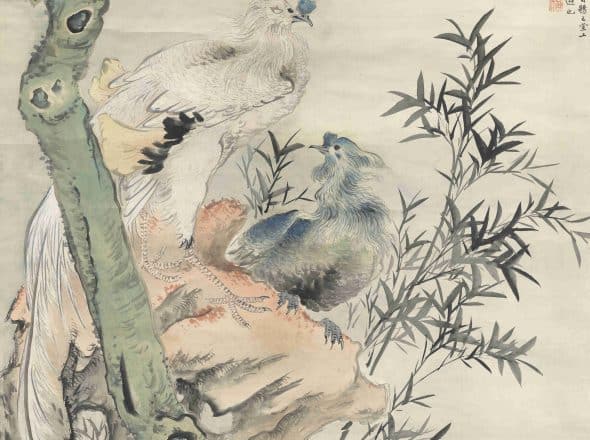
"Harmony of Phoenixes" (1895)
"Harmony of Phoenixes" symbolizes the harmonious relationship between a husband and wife through the imagery of the phoenix and the luan bird singing in unison. This painting is a tribute to the style of Hua Yan, showcasing elegant brushstrokes and warm, refined coloring. The inscriptions demonstrate Lu Hui's exceptional skill in calligraphy, enhancing the overall artistic impact. Created during his middle years, this work reflects his meticulous attention and is regarded as a high-level achievement in his artistic career.
Zhang Zuyi (1849–1917)
Zhang Zuyi, courtesy name Tixian and pseudonym Leian, was also known as Liangxi Zuoguan Laoren due to his residence in Wuxi. He was a native of Tongcheng, Anhui. From a young age, he had a deep passion for epigraphy and calligraphy, mastering various script forms. His works in regular and running scripts displayed a monumental quality, but his achievements in seal and clerical scripts surpassed those in cursive and running scripts. Zhang spent much of his life in Shanghai, where he became renowned alongside Wu Changshuo, Gao Yongzhi, and Wang Xun. Occasionally, he also painted orchids and bamboo, infusing them with artistic charm. Zhang was highly accomplished in the appraisal of calligraphy and inscriptions and amassed a significant collection, though the scattered nature of his materials has left modern research lacking. Among his published works are Leian Jinshi Bawei and Hanbei Fan.
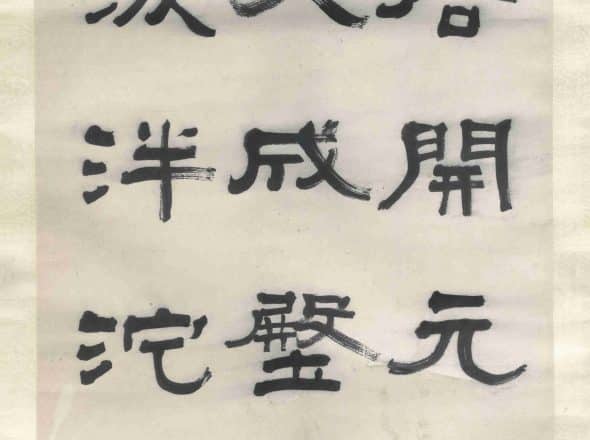
"Four-Screen Series of Inscribed Stele Rubs in Clerical Script"
This set of four panels in clerical script showcases an extraordinary depth of power, with each stroke penetrating to the back of the paper and exuding a profound sense of antiquity. The brushwork is fluid and expansive, imbued with a dynamic rhythm that resembles birds in flight, full of vitality and grandeur. It exemplifies Zhang's mastery, embodying the phrase “heavenly essence unfolding, with force and charm in full measure.” It is no wonder that critics regard Zhang Zuyi as the foremost practitioner of clerical script after Yang Xian.
Yang Yisun (1813–1881)
Yang Yisun, courtesy name Ziyu and pseudonym Yongchun, later signed as Haoguan, Haosou, and Guanhao Jushi, was a native of Tianzhuang, Changshu (present-day Zhangjiagang, Jiangsu). Born into a scholarly family, Yang displayed a strong passion for learning from a young age. He studied under the representative scholar of the Changzhou "Yanghu Literary School," Li Zhaoluo, focusing on classical texts and philology, with a particular interest in The Guanzi and Zhuangzi. In 1843, during the 23rd year of the Daoguang reign, he became a successful imperial examination candidate. In 1853, Yang was appointed as magistrate of Tongling, Anhui, and later transferred to Yishan. Due to the Taiping Rebellion, he could not assume his post. He supported military affairs under the governors of Anhui and Jiangxi, receiving a promotion to prefect of Fengyang for his contributions. After mourning his father's death in 1868, Yang declined to return to office and instead devoted himself to scholarship and calligraphy. In his later years, he settled in Ancheng (modern Qianshan, Anhui), earning a living through his artistry.
Yang Yisun's greatest achievements in calligraphy lay in seal script, which had a profound influence on later generations. His seal script, characterized by sturdy and solid strokes, inherited the legacy of Deng Shiru. However, Yang surpassed Deng in rhythm and variation of ink tones, achieving a dynamic balance of movement and stillness. Structurally, he modeled his style on The Stone Drum Inscriptions, breaking away from the rigid and elongated forms of Qin dynasty small seal script and instead adopting a more square and ancient aesthetic.
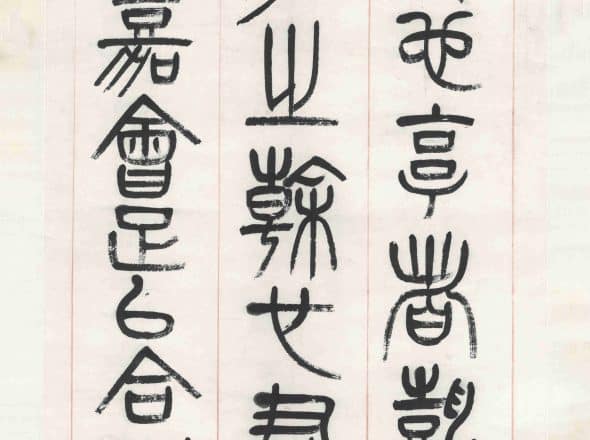
"Excerpts from 'The Commentary on The Book of Changes' in Seal Script" (1879)
This four-panel screen is considered one of Yang Yisun's masterpieces. The paper's durability, the ink's depth, and the brushwork's solidity earned it the description of "cutting three layers into wood." The fluent and meticulous strokes demonstrate a unity of mind and hand, making this work exceptionally precious.