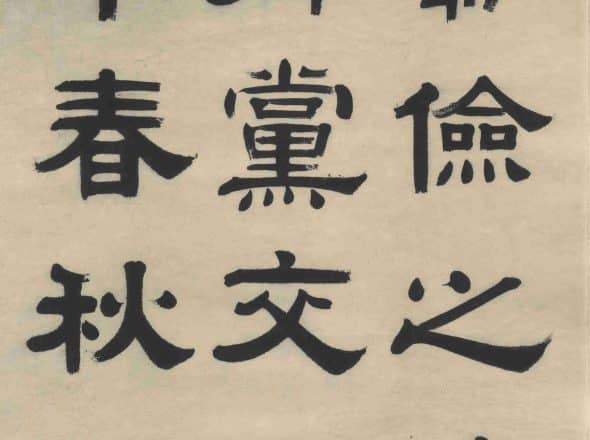
Yi Lixun (1856–1942)
Yi Lixun, courtesy name Xiji, pseudonym Junzhai and Shiqin, also known as Shiqin Laoren and Shiqin Guan Zhu, was a renowned calligrapher from Ninghua, Fujian, and the great-grandson of the famous Qing dynasty calligrapher Yi Bingshou. From a young age, he was influenced by his family's scholarly environment and became highly knowledgeable, particularly excelling in calligraphy. Yi mastered various scripts, including regular, cursive, seal, and clerical, with profound skill. He served as the magistrate of Wuxi during the Guangxu reign and later lived in Shanghai during the Republic of China, making a living by selling his calligraphy.
Yi Lixun's most accomplished work was in the clerical script of the Han dynasty. His clerical script inherited the refined and ancient style of his ancestor Yi Bingshou, with a composed and leisurely demeanor, displaying a sense of liveliness and charm within a strict and simple framework. In the aesthetic appeal of form, his brushwork conveyed a sense of depth and excellence. However, compared to Yi Bingshou, Yi Lixun's work could be overly meticulous, sometimes exhibiting a sense of craftsmanship, and lacked the grandeur and depth of his ancestor. His work can be considered to be of the "competent grade." The "Yin Zhou Stele" originally featured a tightened center and extended strokes, but Yi Lixun's rendition contracted the originally extended strokes, resulting in a more solid and robust style, representing a unique interpretation.
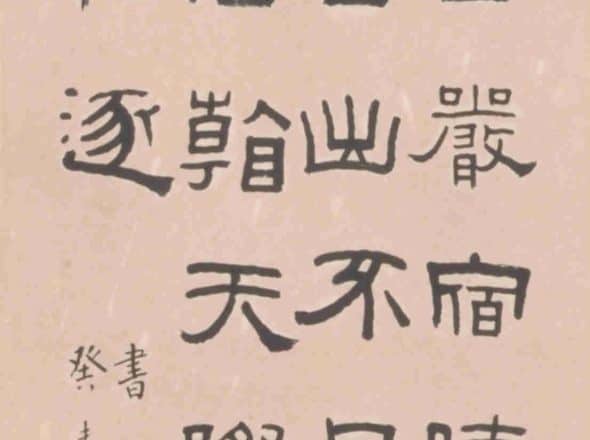
Wang Fuchang (1879–1960)
Wang Fuchang, given name Chi, courtesy name Weiji, pseudonym Fuchang, and after the age of seventy, self-styled as Chimo Laoren, was a renowned modern calligrapher and seal carver from Hangzhou, Zhejiang. He was particularly skilled in seal script and clerical script and, along with Wu Changshuo and Ding Ren, founded the Xiling Seal Art Society during the late Qing dynasty. In the early Republic of China, he moved to Beijing and worked at the Mint Bureau, later moving to Shanghai where he made a living by selling his calligraphy and seal carvings. After the liberation, he became a painter at the China Academy of Art.
Wang Fuchang's calligraphy is known for its elegant and graceful brushwork, with beautiful and solid lines. His seal and clerical scripts are highly regarded. In his use of lines, he paid particular attention to starting and ending strokes, achieving a balance of strength and grace. His characters are symmetrical and balanced, with long and flowing strokes, creating a sense of reserved elegance and serene dignity. His clerical script is as refined as his seal script, with distinct personal characteristics. However, due to his slow and even brushwork, there can sometimes be a sense of monotony. His strengths and weaknesses lie in this approach.
This book was written in the fourth year of Jiaqing, when Liang was 77 years old. The back of the inscription bears a small long seal in Zhu Wen of "Mizhong Beiren." Wu Changhai (Xunpu) signed the seal in regular script, Chen Hongshou signed the fan page in official script, and the last page bears the seal of "Shu Zhai Approval" by Jin Tingke and Gao Xianglin Baoyan. It also bears a Zhai collection seal. The first eight chapters are titled "Offerings of the Dharma Taught by Vimalakīrti," and the last ten chapters are titled "The Immeasurable Sutra of Virtue." Liang's small regular script throughout the book is agile, casual, and natural, without any rigidity. It appears neat and varied, calm and vivid, and has high artistic value in calligraphy.
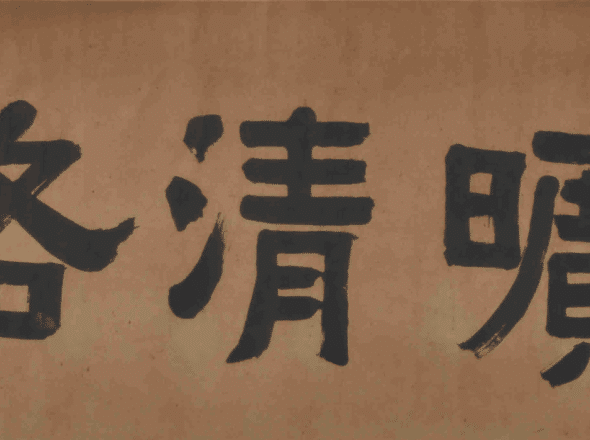
Jing Hengyi (1877–1938)
Jing Hengyi, courtesy name Ziyuan, pseudonym Shichan, and later Yiyuan, was from Shangyu, Zhejiang. He was a renowned modern educator, calligrapher, and painter. In the 28th year of the Guangxu reign (1902), he studied in Japan and returned to China to help establish the Zhejiang Provincial Normal School. After the Xinhai Revolution, he became the principal of the school and concurrently served as the president of the Zhejiang Provincial Education Association. During the May Fourth Movement, he encouraged and supported patriotic democratic struggles, advocated for the New Culture Movement, and boldly reformed education. Due to the opposition of conservative forces, he left his position. In 1925, he participated in the First National Revolution and held positions such as a standing member of the National Government, a member of the Education Administrative Committee, and vice president of Sun Yat-sen University.
Jing Hengyi was deeply influenced by the Stele School of thought, focusing on clerical script in his calligraphy, particularly favoring the "two types of Cuan." This work, created in the "Cuan style" of large characters, features slow and substantial lines, blending a sense of grandeur with elegance, showcasing his exceptional skill.
Translation of the inscription: "Broad and clear." Inscription: "For Yunmen, by Hengyi." Below the inscription are the white seal "Chanzi Jushi" and the red seal "Jingshi Hengyi."
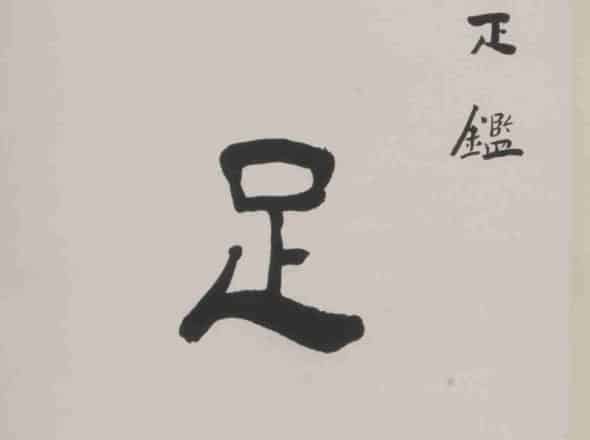
Shen Enfu (1864–1949)
Shen Enfu, courtesy name Xinqing, was born in Wu County, Suzhou Prefecture, Jiangsu (now Suzhou, Jiangsu Province). He was a modern educator and the fourth president of Tongji University. By the age of four, he was literate, and at six, he began teaching students his age on behalf of his mother, earning the saying, "A six-year-old teacher, unheard of in ancient times."
Shen Enfu was a prominent modern educator, and his works are extremely rare and precious. This couplet, written for Mr. Liu Guojun, reflects his elegant and refined style, making it a highly valuable piece despite Shen not being a professional calligrapher.
Translation of couplet: "This day is worth cherishing, One's soul desires to dissipate."
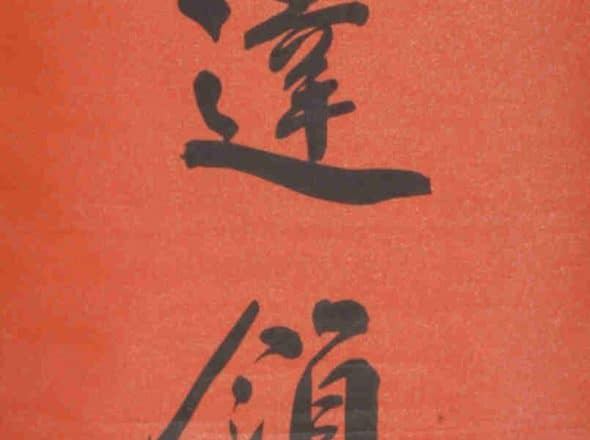
Zhang Jian (1853–1926)
Zhang Jian, courtesy name Jizhi and pseudonym Se'an, was from Nantong, Jiangsu. In the 20th year of the Guangxu reign (1894), he achieved the highest rank in the imperial examination and was known as one of the "Five Talents of Jiangsu." Zhang was a prominent industrialist, politician, educator, and calligrapher in modern China. He had a deep foundation in calligraphy, studying Yan Zhenqing while incorporating Ouyang Xun, resulting in a style that was both profound and elegant, with an outward softness and inner strength. His works were calm and composed, free from the mannerisms of officialdom, exuding an ancient charm from the transformation period of Sui and Tang dynasty regular script.
Zhang Jian's forgeries and ghostwritten works are numerous, but none can match the spirit and essence of his authentic calligraphy. This couplet exemplifies Zhang Jian's typical style, with elegant and robust structures, filled with dignified and scholarly spirit.
Translation of couplet: "Radiate with the predecessors, leading the successors; Gather the elite, encompassing the talents of the time."
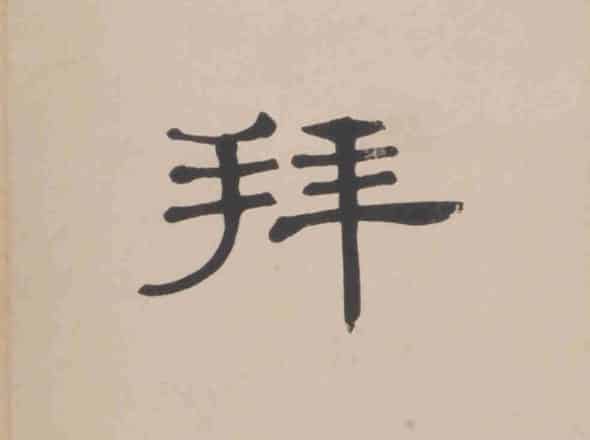
Lu Zhonglin (1884–1966)
Lu Zhonglin, courtesy name Ruibo, was from Dingzhou, Hebei, and a prominent general of the Northwest Army. After meeting Feng Yuxiang during their time in the Beiyang New Army's military academy, Lu followed Feng through forty years of military life, becoming Feng's trusted assistant. During the "Beijing Coup," he led his troops into the city without a single shot being fired, controlling the entire city of Beijing within three days and driving the last emperor, Puyi, out of the palace and into civilian life. After the Northern Expedition, Lu held key positions such as member of the Nanjing Military Commission, Deputy Minister and Acting Minister of Military and Political Affairs, Chairman of Hebei Province, and Minister of Military Affairs.
Lu Zhonglin was a notable figure in modern military and political history and, like Feng Yuxiang, enjoyed calligraphy, often creating works in clerical script. Although not a professional calligrapher, his works were simple yet majestic, reflecting his extraordinary demeanor, as seen in this couplet.
Translation of couplet: "Encountering stone, not bowing but saluting, Comparing wine to saints, even more than wise men."
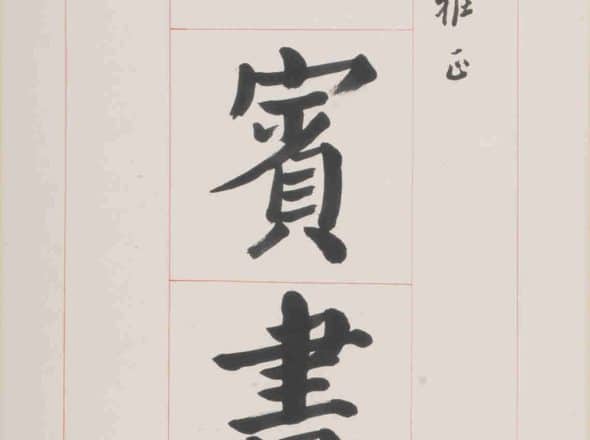
Xia Jingguan (1875–1953)
Xia Jingguan, courtesy name Jiancheng, pseudonym Ying'an, was from Xinjian, Jiangxi. In the 20th year of the Guangxu reign (1894), he passed the provincial examination. He served as the superintendent of Sanjiang Normal School, Fudan Public School, and China Public School, and as the education commissioner of Jiangsu. During the Republic of China period, he held positions such as the director of the Zhejiang Education Department and the director of the Beijing Library. In his later years, he lived in Shanghai, making a living by selling his paintings.
Xia Jingguan was a renowned lyricist and also skilled in calligraphy and painting during the late Qing and Republic of China periods. His calligraphy traced back from Tang dynasty regular script to Wei stele, possessing a clear and simple quality. It combined the meticulous elegance of Tang calligraphy with the natural spontaneity of stele studies, embodying both the refined and robust qualities. This couplet exemplifies his calligraphic style, with sturdy and elegant brushwork, making it a significant piece of his work.
Translation of couplet: "The inkstone moves like dragon guests, the writing drafts like tiger servants; The cup conveys the wisdom of Lei Zu, the archery uses the skill of Niu Weng."
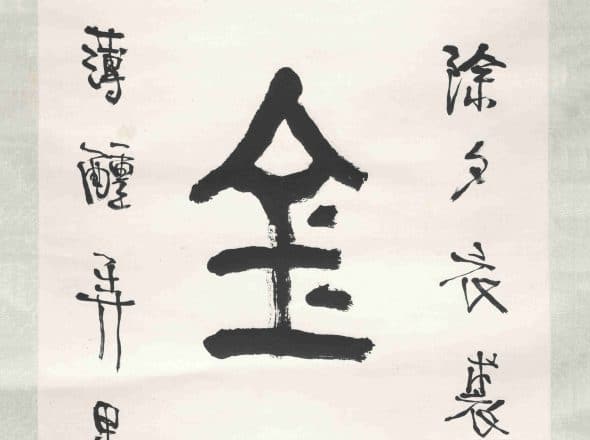
Li Ruiqing (1867–1920)
Li Ruiqing, courtesy name Zhonglin, pseudonym Meian and Qing Daoren, was a renowned educator, calligrapher, and painter from Linchuan, Jiangxi. In the 21st year of the Guangxu reign (1895), he passed the imperial examination and was selected as a Hanlin Academy compiler. He once served as the superintendent of Liangjiang Normal School (renamed Nanjing University in 1949). After the outbreak of the Xinhai Revolution, he moved to Shanghai, dressed as a Taoist, and lived as a recluse under the name "Qing Daoren," making a living by teaching and selling his art. He was a close friend of the famous calligrapher Zeng Xi, who called his calligraphy style the "Southern School," while Li's was known as the "Northern School." Together, they were celebrated as "Southern Zeng and Northern Li."
Li Ruiqing's calligraphy traced back to the Zhou and Qin dynasties, extensively studying the Han and Wei dynasties, mastering various scripts, and especially favoring the Northern Stele style, excelling in seal script and clerical script. His reproductions of Zhong Ding, Han, and Wei stele inscriptions were widely printed during the Republic of China period, gaining significant fame. His large seal script drew from the ancient bronze inscriptions, particularly admiring the "San'shi Pan" and "Mao Gong Ding." This couplet was composed using characters from the "Mao Gong Ding." He employed trembling and shaking brushstrokes to create a "metal and stone flavor." Despite varying opinions, his brushwork was mature and strong, with a distinct style, contrasting sharply with the fluid and smooth calligraphy of Zeng Xi's "Southern School."
Translation of couplet: "I have a golden goblet of wine, People cherish the treasured inscriptions."
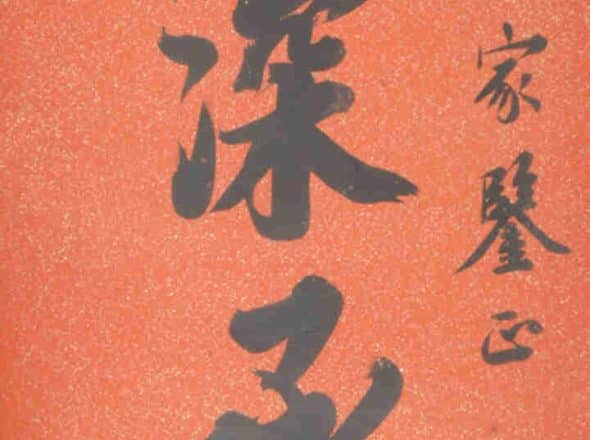
Qian Chongwei (1870–1969)
Qian Chongwei, courtesy names Ziyan and Ciyan, and with the pseudonyms Chong'an and Cunyan, was from Wujiang, Jiangsu (now Suzhou Wujiang District). In the 30th year of the Guangxu reign (1904), he passed the imperial examination and entered the Hanlin Academy. The following year, he went to Japan to study law at government expense. Upon returning to China, he was elected as a member of the Jiangnan Consultative Bureau. During the early Republic of China, he served as the Chief Prosecutor of the Jiangsu Provincial High Procuratorate. When the Japanese army occupied Wujiang, he sought refuge with his close friend Zhu Yuanzhi. In 1938, Zhu became the puppet county magistrate of Wujiang and tried to lure Qian out with the position of deputy county magistrate, but Qian was unmoved and fled to Shanghai, making a living by writing and selling his calligraphy until the liberation. After the founding of the People's Republic of China, he served as the Director of the Jiangsu Provincial Literature and History Research Institute.
Qian Chongwei, who passed the imperial examination, had profound calligraphy skills, and remarkably, his work did not bear the official style. His calligraphy mainly followed Yan Zhenqing and also referenced the Wei stele, resulting in a heavy and solid ink style that set him apart from typical Hanlin calligraphers. This couplet, written for Mr. Liu Guojun, exemplifies his large-character calligraphy and attests to their friendship. It is quite remarkable.
Translation of couplet: "In exploring and delving deeply, we uphold the duty of creation; Inheriting the flourishing legacy, nurturing the path and enriching literature."
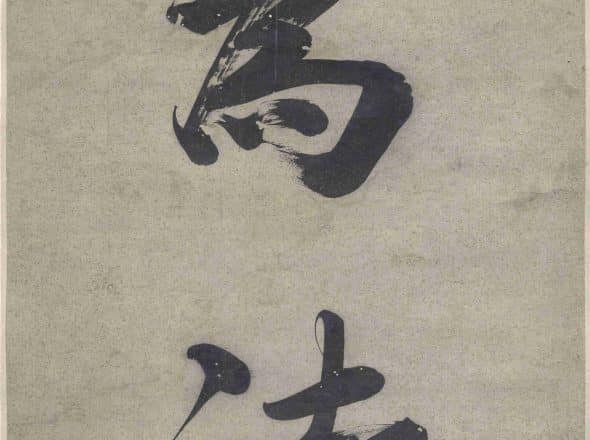
Lin Zexu (1785–1850)
Lin Zexu, courtesy name Yuanfu, also known by the names Shaomu and Shilin, and later referred to himself as Sicun Laoren, Sicun Tuisou, Qishierfeng Tuisou, Pingquan Jushi, and Lishe Sanren, was from Houguan, Fujian (now Fuzhou city). He was a politician, thinker, poet, and calligrapher during the Qing dynasty. Lin held positions such as Viceroy of Huguang, Viceroy of Shaanxi-Gansu, and Viceroy of Yunnan-Guizhou, and was appointed imperial commissioner twice. He advocated for "opening one's eyes to the world" and "learning from foreign skills to control foreigners," and strongly opposed the opium trade, overseeing the "Destruction of Opium at Humen," earning him the title of national hero.
Lin Zexu's calligraphy in regular script was primarily based on Ouyang Xun, while his running and cursive scripts followed the style of "The Preface to the Sacred Teachings" by Wang Xizhi, belonging to the traditional copybook school, known for its steadfast and elegant strength. This piece demonstrates solid brushwork with clear, deliberate strokes, creating a sense of rhythm and depth. The writing conveys a refined, mellow, and steady beauty.
Translation of couplet: "Spring's breath is felt by poets, Nighttime sitting deepens the principles of painting."
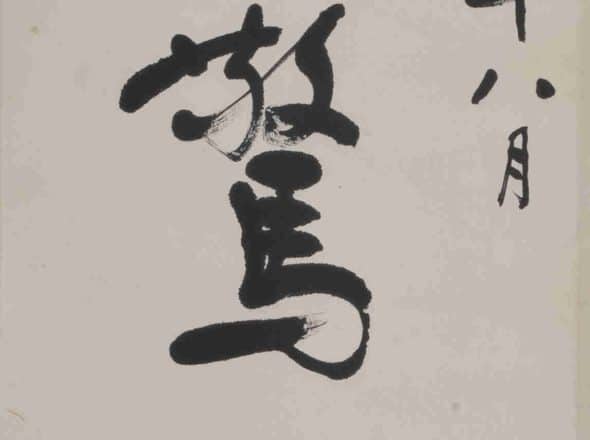
Xu Beihong (1895–1953)
Xu Beihong, originally named Shoukang, was a renowned painter and art educator from Yixing, Jiangsu. From a young age, he studied painting with his father. In 1919, he went to France to study and traveled throughout Western Europe, systematically learning Western painting techniques and dedicating himself to the reform of Chinese painting. He served as a professor at the Central University Art Department and, after the founding of the People's Republic of China, became the president of the Central Academy of Fine Arts. Xu excelled in sketching, oil painting, and Chinese painting, integrating Western artistic methods into Chinese painting, creating a novel and unique style.
Xu Beihong studied under Kang Youwei, and his calligraphy was greatly influenced by Kang. However, he did not merely imitate Kang’s appearance but rather embraced Kang’s calligraphic philosophy, adhering to the stele school. Through extensive study, he developed his distinctive style. His calligraphy was both robust and graceful, possessing the monumental quality of the stele school while maintaining the elegance of the copybook school. This couplet is one of his large-character works, with strong and vigorous brushstrokes, penetrating the paper deeply, and the heavy ink exuding a sense of solid and unadorned beauty.
Translation of couplet: "Marvelous paintings astonish the wind and rain, True art moves gods and spirits to tears."
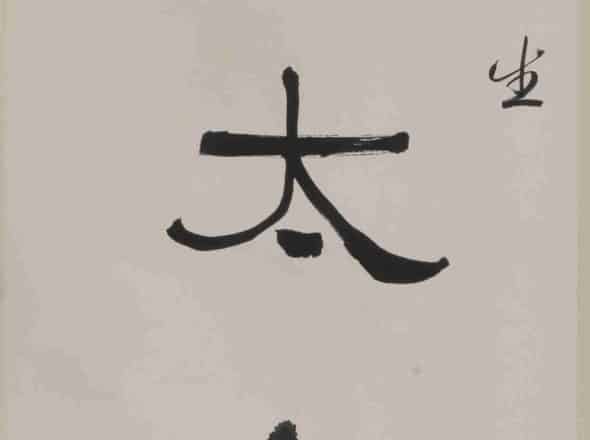
Feng Yuxiang (1882–1948)
Feng Yuxiang, originally named Jishan, also known as Yuxiang, with the courtesy name Huanzhang, was from Chaoxian, Anhui (now Chaohu City). He grew up in Baoding, Zhili (now Hebei). During the Republic of China period, he was the commander-in-chief of the Northwest Army and the highest military and political leader. Feng was an avid reader and talented writer throughout his life. Known for his strict military discipline and excellent training methods, he was called the "Cloth-Bag General."
Feng Yuxiang was a prominent figure in the political scene during the Republic of China and excelled in clerical and running script. This couplet was given to the patriotic entrepreneur Mr. Liu Guojun, attesting to their friendship. The brushwork in this piece is profound and rich, capturing the spirit of Han dynasty clerical script. Although Feng was not a professional calligrapher, his work is imbued with a unique charm, making it quite exceptional.
Translation of couplet: "In the study, the simplicity of the historiographer's bamboo slips, Like the pen of Dong Hu of Jin."