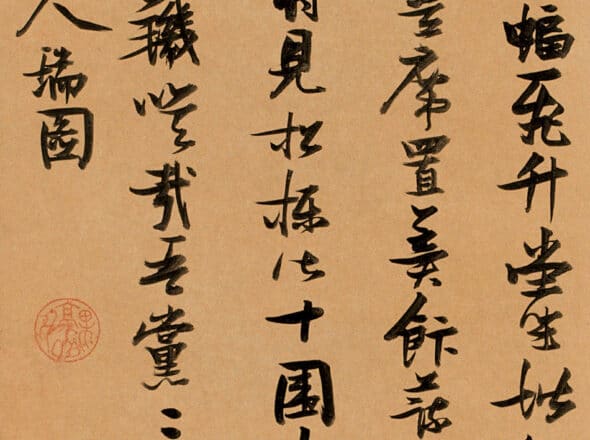
Zhang Ruitu (1570–1641)
Zhang Ruitu, courtesy name Chang Gong, pseudonyms Ershui, Guoting Shanren, Jiezi Jushi, Pingdeng Jushi, among others, was from Jinjiang, Fujian. He achieved the highest scholarly honor in the 35th year of Wanli (1607) and was appointed as a compiler at the Hanlin Academy. Recognized by Wei Zhongxian, he entered the cabinet as the Minister of Rites in the 6th year of Tianqi (1626). Zhang Ruitu was renowned for his calligraphy, and alongside Dong Qichang, Xing Tong, and Mi Wanzhong, he was highly esteemed. Many of the inscriptions on Wei Zhongxian's temples were penned by him.
"Han Yu's "Mountain Rock" Poem in Running Cursive Script" (1628)
Compared to his calligraphy on scrolls, Zhang Ruitu rarely dated his hanging scrolls. This piece of running-cursive script features Han Yu's poem "Mountain Rock," dated the summer of the first year of Chongzhen (1628) and written on a boat in the Jihe River, which is quite rare. At the age of 59, Zhang was returning home after resigning from office. Han Yu's poem describes the perilous mountain paths and difficult travel, perhaps reflecting Zhang's own uncertain future after Wei Zhongxian's execution. The instability of the boat led to errors in some characters, and the cramped space restrained his usually bold style, resulting in a calm and substantial work with high artistic value.
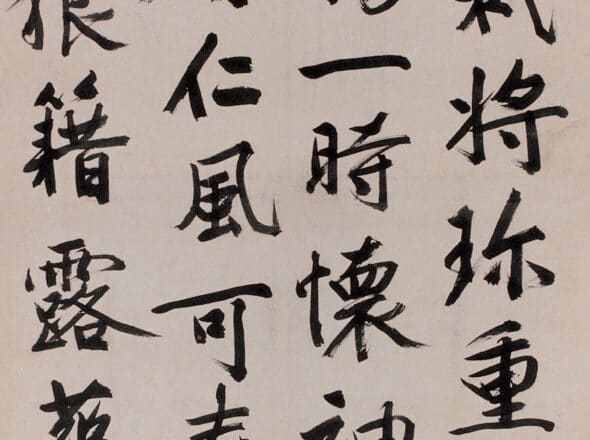
Wen Zhengming (1470–1559)
Born Wen Bi, with courtesy names Zhengming and later Xing and Zhengzhong, Wen Zhengming was a renowned painter, calligrapher, and poet from Changzhou (modern-day Suzhou, Jiangsu Province). He was a central figure in the Wu School of Painting and Calligraphy, which included luminaries such as Shen Zhou, Tang Yin, and Qiu Ying, collectively referred to as the "Four Masters of the Wu School."
In his early years, Wen studied painting under Shen Zhou, calligraphy with Li Yingzhen, and literature under Wu Kuan. Despite his dedication, he struggled to succeed in the imperial examinations. It was not until his fifties, through the recommendation of Li Kecheng, Governor of Jiangsu, that he was appointed to the prestigious Hanlin Academy, earning him the title "Wen Daizhao." Known for his cautious diligence, Wen dedicated himself to refining his skills in poetry, painting, and calligraphy, leaving a profound legacy in Chinese art history.
"Seven-Character Poem in Running Script Written by Myself"
Wen Zhengming’s calligraphy, celebrated for its elegance and depth, remained exceptional even in his later years. This work, created when Wen was in his eighties, exemplifies his mastery of running script. Standing nearly three and a half meters tall, with characters approximately 25 centimeters in size, it is a rare example of large-scale calligraphy from his oeuvre.