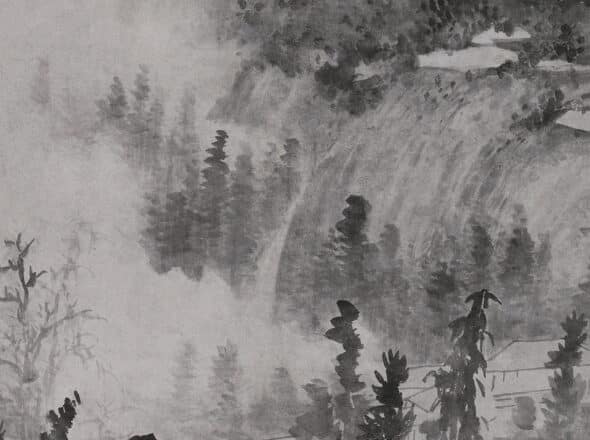
"Yun Xiang (1586–1655)
Yun Xiang, originally named Benchu, later changed to Xiang, with courtesy names Daosheng and Shuchen, and the pseudonym Xiangshan, was from Wujin (present-day Changzhou), Jiangsu. He excelled in poetry, calligraphy, and painting, particularly known for his landscape paintings. In his early years, he painted extensively, but in later years he became more restrained, significantly influencing his nephew Yun Shouping.
""Inspired by Dong Yuan and Ju Ran"" (1633)
This painting was created by Yun Xiang at the age of 47 for his ""society brother Ziyu."" The ""society"" likely refers to the Fushe, which Yun joined in the second year of Chongzhen (1629). Although the identity of ""Ziyu society brother"" is unclear, it may have been Huang Yisheng from Taicang. The painting, inspired by Dong Yuan, depicts the lush scenery of a summer mountain after rain. While elements of Dong Yuan and Juran's style are evident, Yun Xiang's brushwork and composition are uniquely his own. Influenced by the prevailing trend of antiquity, Yun Xiang's works often reflect a deep understanding and pursuit of ancient styles, as he stated, ""Recent painters emulate Dong Yuan and Wu Zhen without understanding their simplicity, only seeking density without embracing sparsity."" This piece achieves a balance of dense and sparse with broad, expressive strokes, capturing the essence of mist and ink. The piece is an early masterpiece of Yun Xiang's artistry, representing his best work from this period. Du Fu's poem aptly describes it: ""The primordial spirit seeps through the screen, even the heavens weep at the true essence conveyed.""
"
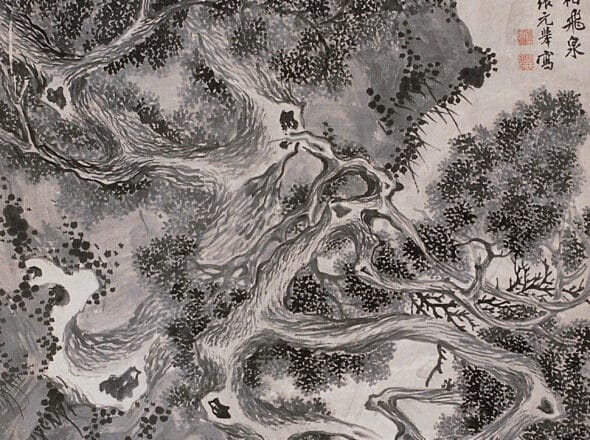
Zhang Yuanju, also known as Maoxian and Wuhu, was a skilled painter whose birth and death dates remain a mystery. Hailing from Wuxian County, now part of Suzhou in Jiangsu Province, Zhang drew inspiration from the biography of his maternal ancestor Chen Daofu. He had a remarkable talent for painting flowers and birds, which he portrayed in a vivid and charming manner. Despite offers of money and silk, Zhang preferred to indulge in good wine. He also possessed a free-flowing writing style, which he inherited from the elegant Ming Dynasty.
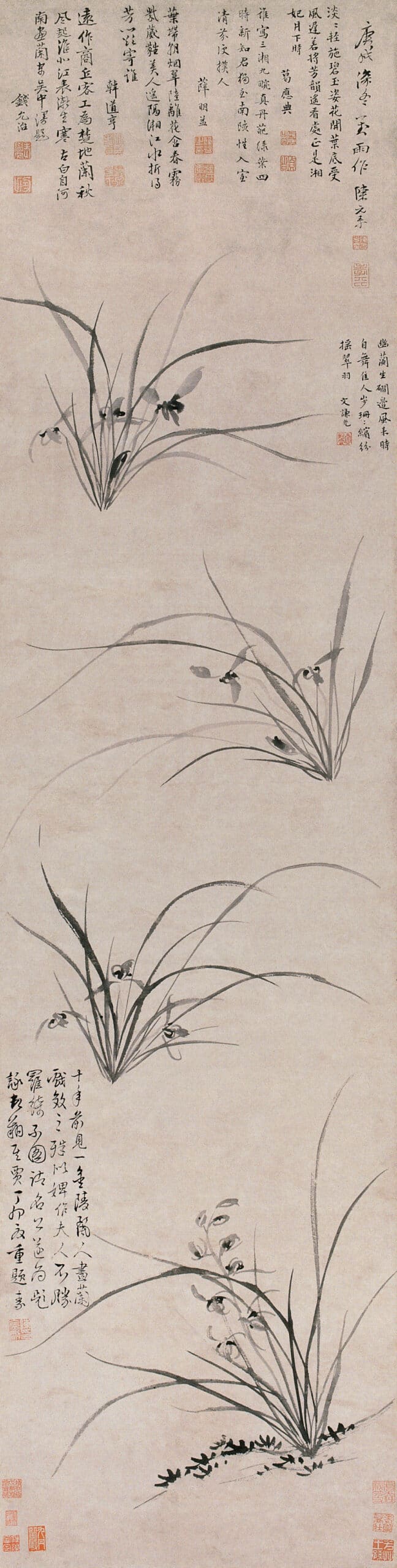
Chen Yuansu (dates unknown)
Chen Yuansu, courtesy name Gubai, also known as Xiaoping and Jingan, with the pseudonym Su Weng and Chukuo Xiansheng, was from Changzhou (present-day Suzhou), Jiangsu. After failing the provincial examination in the 34th year of Wanli (1606), he dedicated himself to calligraphy and painting, also excelling in poetry and prose, earning fame during his time. He was skilled in landscape painting with a clear and distant brushwork and was particularly good at painting orchids. His orchid leaves curved gracefully, and ink flowers overflowed with elegance, capturing the refined essence of Wen Zhengming. His calligraphy was strong and clear, with his regular script following Ouyang Xun, and his running-cursive script inspired by the two Wangs and Wen Zhengming. His talent was well-regarded, attracting many followers.
"Orchid"(1610)
This early work by Chen Yuansu, although slightly immature, displays elegant orchid leaves exuding an otherworldly charm, vividly expressing a refined atmosphere. The inscription reads: "Painted in the late winter of the year Gengxu, Chen Yuansu." The seals include "Seal of Chen Yuansu" in white and "Xiaoping" in red. Another inscription on the lower left reads: "Ten years ago, I saw a beautiful woman in Jinling painting orchids. I imitated it playfully, resembling a maid dressed as a lady, overwhelmed by ornaments. Not seeking fame, you inscribed it, soaring its value. Summer of Dingmao year, re-inscribed by Su." The seal below the inscription reads "Seal of Chen Jingang" in white. The painting bears additional inscriptions by renowned collectors, including Ge Yingtian, Xue Mingyi, and Han Daoheng, adding to its value.
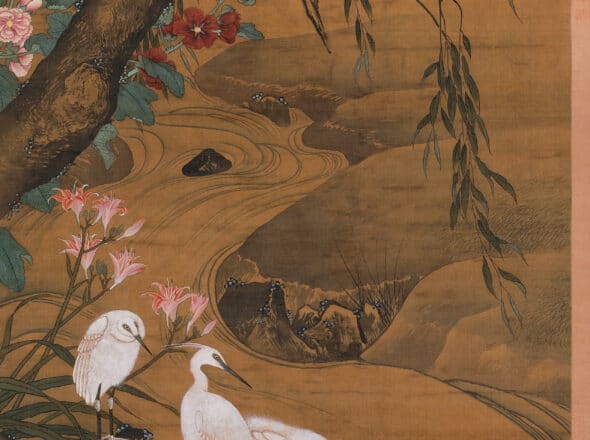
Lu Ji was an artist of great talent, born in 1477 in Ningbo, Zhejiang Province, China. He was known by his courtesy name Tingzhen and his nickname Leyu. Lu Ji served as an official in the command of Jin Yiwei and was renowned for his skill in painting flowers and birds. He received his education under Bian Jingzhao and attended the Academy of the Southern Song Dynasty. His paintings often featured a variety of eye-catching birds and flowers, including phoenixes, cranes, peacocks, and mandarin ducks, which were popular in ancient times.
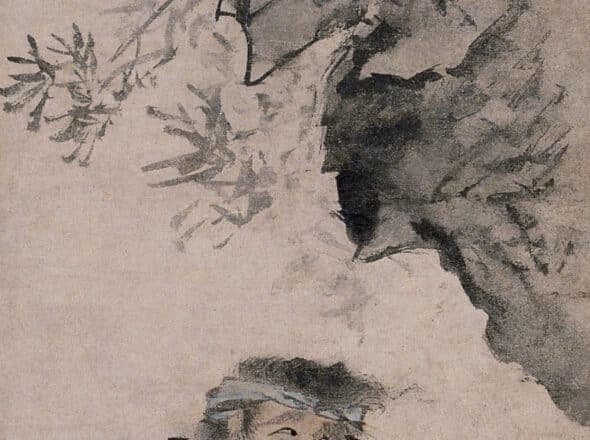
Wu Wei, courtesy name Shiying and aliases Ciweng, Lufu, and Xiaoxian, was a native of Jiangxia (now Wuhan, Hubei). As a prominent master of the "Zhejiang School" following Dai Jin, he was renowned for his expertise in figure and landscape painting. In his early years, Wu Wei's style was meticulous and detailed, but in middle age, his work evolved into bold, vigorous brushwork that exuded freedom and expressiveness. He was later celebrated as the founder of the "Jiangxia School."
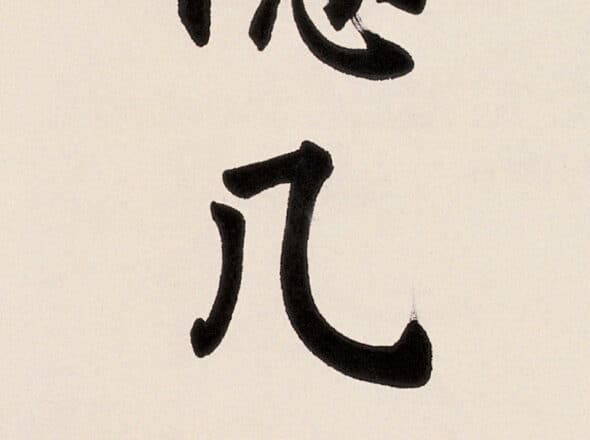
Shen Yinmo (1883–1971)
Shen Yinmo, originally named Junmo, courtesy name Zhong, and pseudonyms Qiuming and Huguan, was originally from Huzhou, Zhejiang, born in Hanyin, Shaanxi. He studied in Japan in his early years and later served as professor and principal of Peking University, and professor at Fu Jen Catholic University. After 1949, he held positions such as Vice Director of the Central Research Institute of Culture and History, member of the Shanghai Municipal People's Government, and representative of the Third National People's Congress. Renowned for his calligraphy, Shen was praised during the early Republic of China era as one of the top calligraphers, alongside Yu Youren ("North Yu and South Shen").
"Seven Character Couplet in Regular Script"
Shen Yinmo possessed profound knowledge in calligraphy, diligently practicing and specializing in the regular script, copying from Tang and Wei dynasty steles, and dedicating himself to the "Two Wangs" for running script, achieving a balance of strict rules and elegance. The noted calligrapher Xie Zhiliu praised him, saying, "For hundreds of years, no one has surpassed him." This running-regular script couplet is based on Chu Suiliang's "Stele of Master Meng" but also incorporates Shen's personal style, representing a standard work of his running-regular script.
Inscription: "Just right to lean on and contemplate all falsities; only knowing to hold wine without worries."
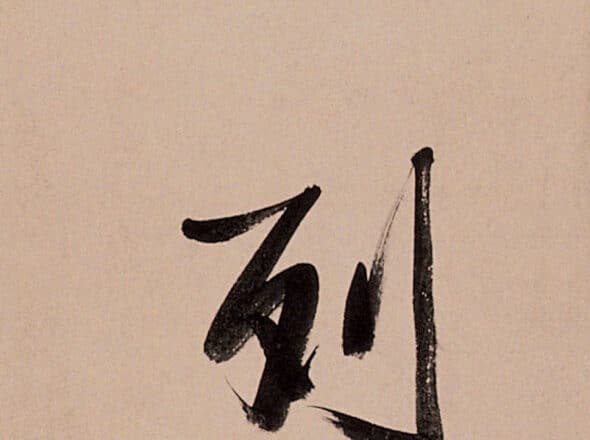
Wu Hufan (1894–1968)
Initially named Yiyan, courtesy name Yujun, later renamed Wan, courtesy name Dongzhuang, and signed his paintings and calligraphy as Hufan. He was the grandson of the renowned painter and collector Wu Dacheng, from Suzhou. Wu Hufan was deeply influenced by his family's artistic environment, excelling in poetry, calligraphy, and painting, with a vast collection. He was one of the twentieth-century Chinese art giants. Along with Pu Ru, he was known as "Southern Wu and Northern Pu," and with Wu Zishen, Wu Daiqiu, and Feng Chaoran, they were collectively called "Three Wus and One Feng."
"Seven Character Couplet in Running Script"
Wu Hufan initially studied the "slender gold" script of Song Huizong and later acquired Mi Fu's "Poetry Scroll of Duojing Tower" manuscript, focusing on Mi Fu's style. He combined the two, capturing Huizong's elegance and Mi's vigor, creating a new style different from the mainstream. This couplet exemplifies his calligraphic style, with harmonious ink and paper interaction, and fluid brushwork, showcasing his skillful writing.
Translation of couplet:
"Books arranged in long and short rows, jade pendants linked together in unity."
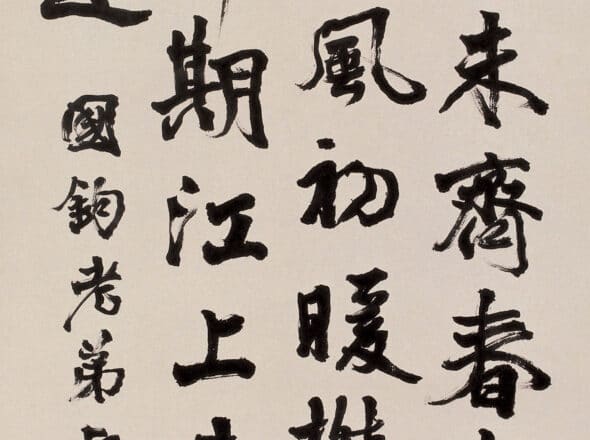
Tang Ken (1876–1950)
Tang Ken, courtesy name Qilin, a descendant of Tang Jinchuan, was from Wujin (present-day Changzhou), Jiangsu. In 1905, he studied law at Chuo University in Japan. After the founding of the Republic of China, he held various military and political positions in Zhili, including acting magistrate of Yixing County. After the Anti-Japanese War, he retired to Shanghai, refusing to accept puppet government positions and made a living through his art. He was skilled in literature, poetry, calligraphy, and painting, with a deep understanding of art appraisal and a vast collection, earning great acclaim.
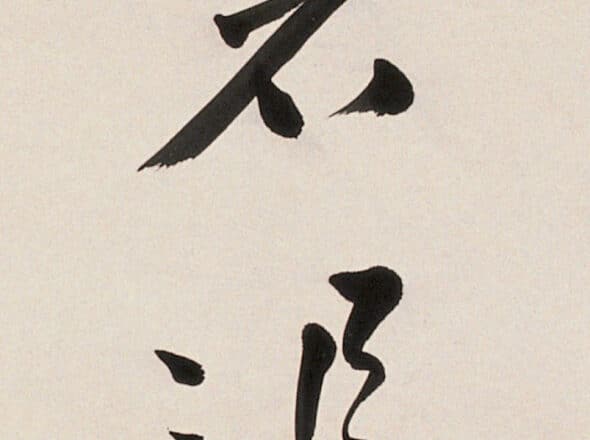
"Five Character Poem in Running Script"
Tang Ken's calligraphy followed the styles of Yan Zhenqing, Liu Gongquan, and the Northern Wei stele, characterized by a grand and majestic feel. This five-character poem scroll was written for Mr. Liu Guojun. It is solemn yet unrestrained, with well-balanced strokes and full of vigor, embodying the spirit of epigraphy and showcasing Tang Ken's meticulous effort.
Ye Gongchuo (1881–1968)
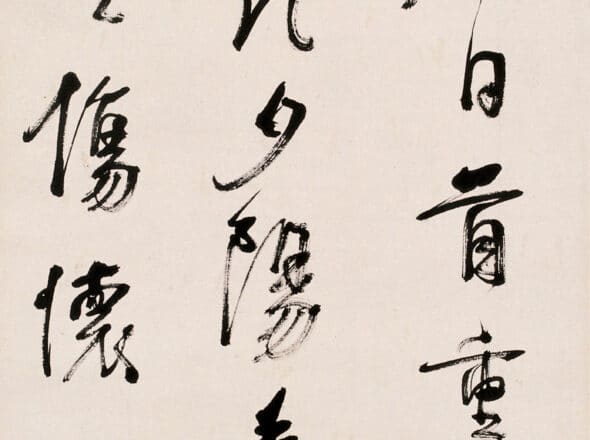
Ye Gongchuo, courtesy name Yufu, also known as Yu Hu and Yu Fu, and with the pseudonym Xia'an, was from Panyu, Guangzhou. Coming from a scholarly family, Ye held significant positions early in his career, such as Minister of Transportation and Minister of Finance. In his mid-years, he dedicated himself to academics, excelling in poetry, archaeology, painting, and art appraisal. He amassed a considerable collection of cultural relics, covering a wide range of categories, and was committed to preserving national treasures. Many ancient texts and cultural relics were meticulously organized and preserved under his care. In his later years, Ye donated his collection of paintings, books, and other important cultural items to the nation for posterity.
Ye Gongchuo claimed that he had never specialized in calligraphy, yet his works were of a high standard, reflecting his natural talent. He excelled particularly in large characters, which were powerful and vigorous, showcasing his extraordinary flair. His running script combined the weight of the Han and Six Dynasties stone inscriptions with the liveliness of the copybook style, incorporating the brushwork of the Zhangcao script, making it unique. This couplet was written in 1943, during his peak creative period. The lines are strong and muscular, the characters' structure is rigorous, slightly short and flat, yet harmoniously composed, displaying graceful and dynamic movements, making it a masterpiece of his work.
Translation of couplet: "Each Pursuit of Elegance Beyond, My Middle Years Consumed by Literature's Craze."
Qian Zhenqian, courtesy name Mengjing and pseudonym Mingshan, was a native of Wujin, Jiangsu (modern-day Changzhou). He earned the title of Jinshi during the 29th year of the Guangxu Emperor's reign (1903) and served as Director of the Ministry of Justice. However, disillusioned by the lack of impact of his reform proposals, Qian resigned from his post and returned to his hometown, where he founded the Jiyuan Academy. As an educator and scholar, he significantly influenced the academic culture of Changzhou, mentoring many students and strengthening intellectual traditions in the region. After the Xinhai Revolution, Qian embraced a life of seclusion, adopting Taoist attire and devoting himself to teaching, writing, and moral advocacy. In a turbulent era marked by both natural disasters and social upheaval, he was revered for his ethical integrity, earning the title of the "Great Confucian Scholar of Jiangnan."
Zeng Xi (1861–1930)
Zeng Xi, originally named Sihuan and later Ziji and Ji Zi, with the pseudonyms Siyuan and Nongran in his later years, was from Hengyang, Hunan. He was a renowned calligrapher, painter, and educator during the late Qing and early Republic of China period, and a leading figure in the Shanghai School of painting and calligraphy. In the 29th year of the Guangxu reign (1903), he passed the imperial examination and served in various governmental roles, including as a secretary of the Ministry of War and a commissioner of education. He later taught at the Shigu Academy in Hengyang and the Longchi Academy in Hanshou, and served as the president of the Hunan Education Association. His calligraphy was known as the "Southern School," rivaling Li Ruiqing's "Northern School," and together they were referred to as "Southern Zeng and Northern Li."
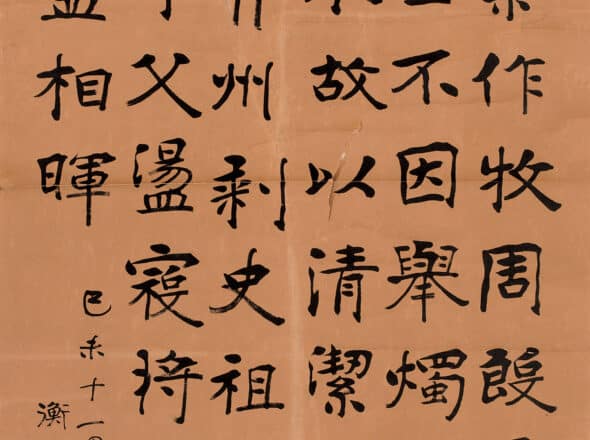
"Four-Screen Series of Zhang Heinu’s Epitaph"
Zeng Xi was deeply influenced by the Stele School of calligraphy, extensively studying seal and clerical scripts from the Northern Stele. He was particularly fascinated by the "Zhang Heinu Tombstone," primarily because it was a unique copy owned by He Shaoji, whose calligraphy was significantly influenced by this piece. Zeng Xi greatly admired He Shaoji and diligently studied his works. Additionally, the "Zhang Heinu Tombstone" retained much of the clerical script's brushwork, giving it an ancient and elegant quality that attracted Zeng Xi. However, Zeng Xi did not merely imitate but creatively incorporated his personal brushstrokes and style into his works. This four-panel screen, with its pure white paper and precise ink, showcases Zeng Xi's controlled brushwork, completed in one continuous flow, making it a masterpiece of his art.
Translation of the inscription: "The principles of mountains and lakes are evident, I can engrave the inscriptions on metal and stone."
Yi Bingshou (1754–1815)
Yi Bingshou, courtesy name Zusi and pseudonym Moqing, was from Ninghua, Fujian. In the 54th year of the Qianlong reign (1789), he passed the imperial examination and served as the prefect of Huizhou and Yangzhou. During his tenure, he was renowned for his "honest governance and good administration." To honor his legacy, the people of Yangzhou included him in the local "Temple of the Three Worthies" (which honored Ouyang Xiu, Su Shi, and Wang Shizhen), renaming it the "Temple of the Four Worthies."
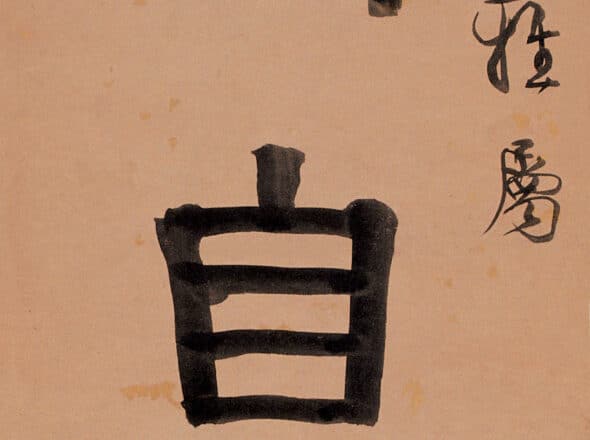
Yi Bingshou's clerical script drew inspiration from Han dynasty steles, incorporating elements from famous Han clerical inscriptions like "Fu Ge Inscription," "Zhang Qian Stele," and "Heng Fang Stele." He also integrated the styles of contemporary masters, using seal script techniques to write clerical script, creating a dignified yet not rigid, heavy yet elegant, exaggerated yet reasonable style. His large characters were particularly remarkable, praised by Liang Zhangju as "the bigger, the stronger." This clerical script couplet features vigorous and composed brushwork, broad and structured composition, and an ancient and refined aesthetic, giving a sense of formal and meticulous beauty.
Translation of couplet: "Using purity brings harmony, Preferring ancient pleasures."