Ren Yi (1840–1896)
Ren Yi, courtesy name Boren, pseudonym Xiaolou, was from Shaoxing, Zhejiang. He learned portrait painting from his father in his youth and later studied painting under Ren Xiong and Ren Xun. He lived in Shanghai, making a living by selling paintings. His techniques were comprehensive, encompassing landscapes, flowers, birds, and figures. Ren Yi inherited the rustic charm of folk painting, incorporating the styles of Chen Hongshou, Chen Chun, Xu Wei, Yun Shouping, Hua Yan, Ren Xiong, and Ren Xun, and absorbed Western sketching and coloring techniques, forming a unique style characterized by simplicity, clarity, and vividness. His work had widespread appeal and a distinct contemporary flavor. Together with Ren Xiong, Ren Xun, and Ren Yu, he was known as one of the "Four Rens of Shanghai," significantly influencing later painting.
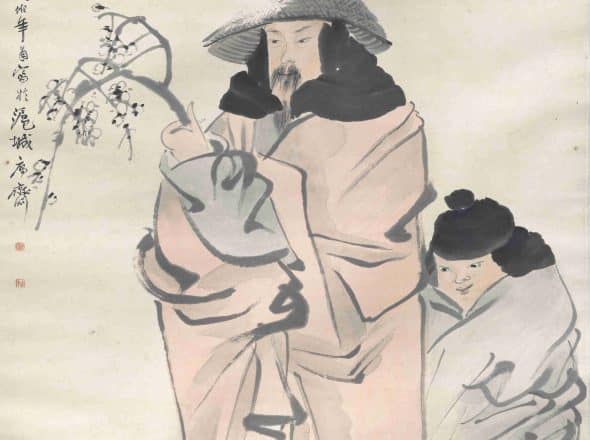
"Seeking Plum Blossoms in the Snow" (1889)
This painting, created in 1889 when Ren Yi was fifty years old, is a late work. The brushwork is simple and the lines are strong and fluid, with a touch of roughness, making it a rare example among his figure paintings. The elderly man depicted wears a bamboo hat, holds a plum branch, and has a joyful expression, allowing the viewer to experience the pure and fragrant world of plum blossoms in the snow, making it highly captivating. The inscription reads: "In the Jia Ping month of the Jichou year of Guangxu, painted by Ren Yi Boren in his studio in Shanghai." The seals read "Ren Yi's seal" and "Boren," with the seal "Yiyi Caotang" at the lower right. The collector's seal "Once in the collection of Liu Guojun" is affixed at the lower left.
Tang Ken (1876–1950)
Tang Ken, courtesy name Qilin, a descendant of Tang Jinchuan, was from Wujin (present-day Changzhou), Jiangsu. In 1905, he studied law at Chuo University in Japan. After the founding of the Republic of China, he held various military and political positions in Zhili, including acting magistrate of Yixing County. After the Anti-Japanese War, he retired to Shanghai, refusing to accept puppet government positions and made a living through his art. He was skilled in literature, poetry, calligraphy, and painting, with a deep understanding of art appraisal and a vast collection, earning great acclaim.
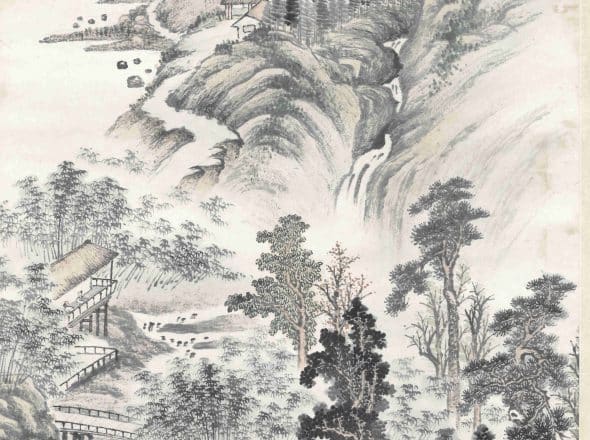
"Pure Enjoyment in Bamboo Grove"
Tang Ken's landscape scroll, created for Mr. Liu Guojun, depicts scenes of ancient trees, bamboo groves, waterfalls, and mountain peaks, not only showcasing the grandeur of landscapes but also conveying a sense of leisurely seclusion in the mountains. His brushwork is powerful and elegant, reflecting his deep mastery of ancient techniques and a keen focus on capturing the spirit of nature to express his personal sentiments. The inscription reads: "Clear charm in a bamboo grove, for the appreciation of Brother Guojun, summer of the Guiwei year, by Tang Ken." The seals read "Tang Ken's private seal" and "Master of Xiaoban Garden."
Wu Daiqiu (1878–1949), Fan Shaoyun (1885–1962), Zhang Xuan (1898–1959)
Wu Daiqiu, named Zheng, courtesy name Daiqiu, and pseudonyms Baoxuan Jushi and Shulin Zhongzi, was from Chongde, Zhejiang. Son of the famous painter Wu Botao, he inherited the family tradition in painting and later studied under Wu Changshuo, excelling in landscapes and flowers, and birds. Together with Wu Hufan, Wu Zishen, and Feng Chaoran, they were known as the "Three Wus and One Feng."
Fan Shaoyun, named Haolin, courtesy name Shaoyun, was from Chongming, Shanghai. He specialized in landscape painting, diligently studying ancient and modern masterpieces, mastering both form and spirit. He later studied under the famous painter Lu Hui, further advancing his skills. Fan was also accomplished in playing the pipa and made significant contributions to traditional Chinese music. After the founding of the People's Republic of China, he served as a painter at the Shanghai Chinese Painting Academy and a member of the Shanghai branch of the Chinese Artists Association.
Zhang Xuan, courtesy name Kehe, pseudonym Mashi Weng, and alternative pseudonym Shiyuan Jushi, was from Wujin (present-day Changzhou), Jiangsu. A renowned painter and connoisseur in Shanghai, he excelled in landscape painting, with a deep foundation in traditional techniques, closely imitating the style of Wang Shigu. His brushwork was both vigorous and elegant, adept in both ink and color.
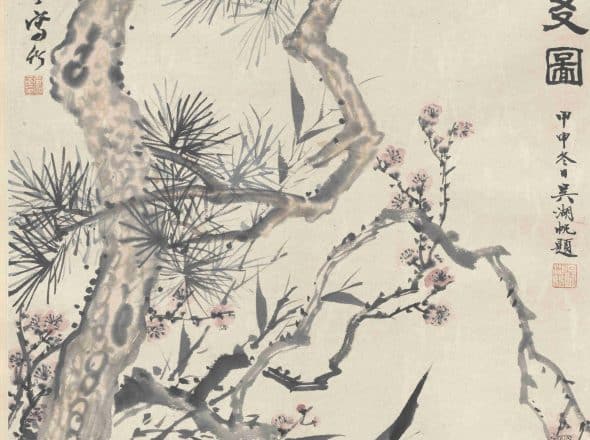
"Collaborative Painting of Three Friends"
This collaborative painting features the works of modern masters. On the right, Wu Hufan inscribed the title and signed: "Three Friends Painting, inscribed by Wu Hufan on a winter day of the Jia Shen year." The seals read "Wu Hufan." In the painting, Fan Shaoyun depicted the pine tree, ancient and rugged; Zhang Xuan painted the slender bamboo, elegant in posture; and Wu Daiqiu painted the red plum, exuding a cold fragrance. Although created separately, the composition is harmonious, exuding a strong literati atmosphere.
Huang Shanshou (1855–1919)
Huang Shanshou, originally named Yao, courtesy names Xuchu and Xuchu, and pseudonyms Lisheng, Xu Daoren, and Huxi Waishi, was from Wujin (present-day Changzhou), Jiangsu. He excelled in painting figures, landscapes, flowers, and animals, especially in ink dragons. For figures, he favored meticulous brushwork and vibrant colors, influenced by Gai Qi and Fei Danxu. His landscapes were renowned for their rich and elegant coloring. His flower and bird paintings skillfully combined the Wujin school's boneless technique with the traditional double-outline method. In his early years, he made a living as a private tutor, and after 1901, he moved to Shanghai, becoming a prominent artist of the Shanghai School.
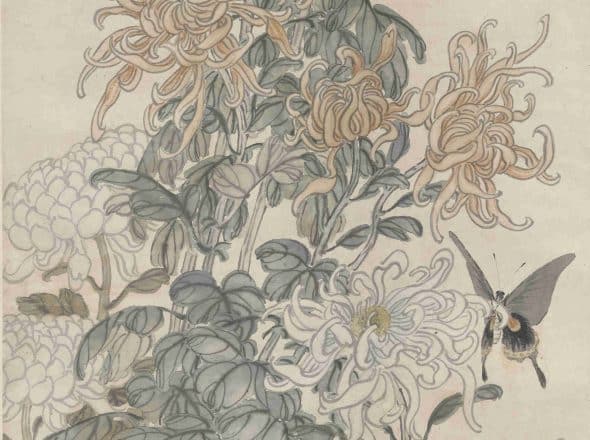
"Five Color Chrysanthemums"
Huang Shanshou's floral paintings were grounded in Yun Shouping's boneless technique but innovatively combined the double-outline method and Western painting techniques. This painting showcases his rich and vibrant coloring and elegant composition, vividly depicting the scene of blooming chrysanthemums. His inscriptions and calligraphy, influenced by Yun Shouping and Zhao Mengfu, seamlessly integrate with his paintings, exuding a refined and elegant style. The inscription reads: "The chrysanthemums bloom in five colors by the fence, resembling a brocade screen. The dazzling colors leave me in awe, do not mock the butterflies' wandering intentions among the flowers. By Xu Huang Shanshou." The seals read "Huang Shanshou" and "Master of Caijing Pavilion."
Bai Jiao (1907–1969)
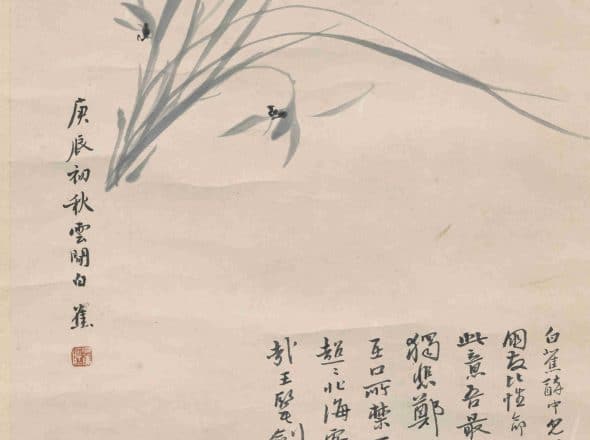
Originally surnamed He, named Fazhi, also known as Fu, with the courtesy name Yuanxiang and the pseudonym Xuru, Bai Jiao was from Jinshan, Shanghai. He excelled in poetry, painting, and seal carving. His poetry was renowned in Jiangzuo, and his prose closely followed the Tang and Song styles. His calligraphy, rooted in the "Two Wangs," also drew from Ouyang Xun and Yu Shinan, making him a prominent figure in twentieth-century calligraphy. He was known for his ancient and elegant orchid paintings, which he rarely created for others.
"Orchid"
Bai Jiao's orchid paintings drew from the strengths of ancient masters, emphasizing both natural inspiration and deep skill. His profound foundation in calligraphy lent precision and elegance to his paintings, imbued with scholarly charm and perfectly capturing the noble and otherworldly essence of orchids. His orchid paintings, along with Shen Shijia's bamboo and Gao Yihou's plum, were known as the "Three Wonders of Shanghai." This work, although composed of a few strokes, displays superior brushwork and an extremely pure and refined aura. The long poem inscribed by his friend, the painter and calligrapher Chen Dingshan, adds significant value.
Wang Zhen (1866–1938)
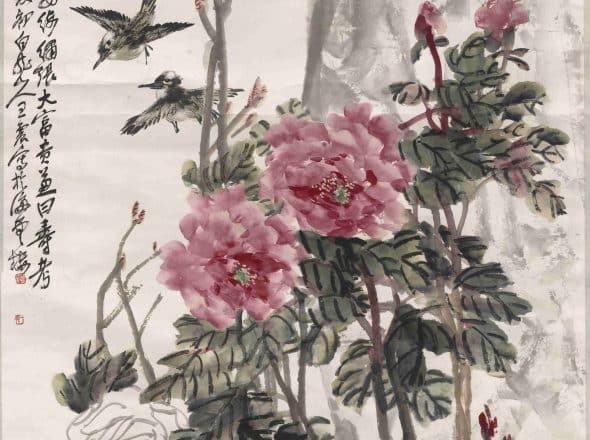
Wang Zhen, courtesy name Yiting, pseudonym Bailong Shanren, was a renowned painter, calligrapher, businessman, and philanthropist from Wuxing (present-day Huzhou), Zhejiang, who resided in Shanghai. In his early years, he studied under Xu Xiaocang and Ren Yi. Later, he developed a close relationship with Wu Changshuo, forming a bond between teacher and friend and achieving equal fame in the Shanghai art scene. Before the age of forty, his style and subjects closely followed Ren Yi. After the age of forty-six, his style shifted towards Wu Changshuo. In his later years, his works combined the essence of Ren Yi and Wu Changshuo, mainly following Wu's style while retaining Ren's elegant charm, which was highly commendable. He excelled in expressive painting, particularly in figures, Buddhas, and flowers and birds, which were highly valued.
"Peony and Small Bird"
This work, created when Wang Zhen was fifty-nine, showcases his mature and refined brushwork. The bold and swift strokes, combined with a rustic charm and vibrant colors, embody an ancient elegance within a strong epigraphic feel, yet retain a refined and elegant touch. The inscription reads: "The fragrant name competes for the title of the king of flowers, even surpassing the embroidered curtains of Chang'an. Great wealth and longevity, envied by the world like Guo Fenyang. Early summer of the Jiazi year, by Bailong Shanren Wang Zhen at Haiyun Tower." The seals read "Wang Zhen Dali" and "Yiting," with the square seal "Ziyuan" at the lower right.
Xiao Yuncong (1596–1673)
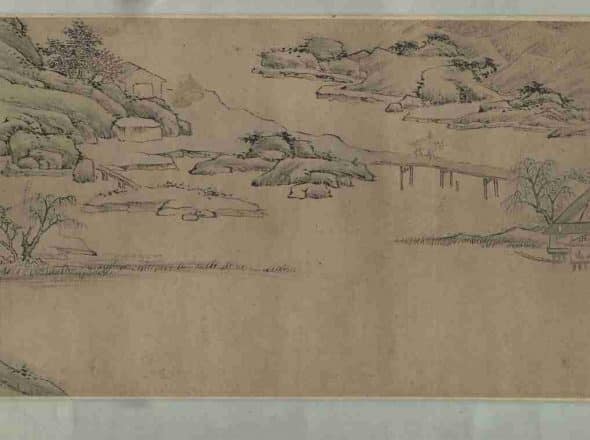
Xiao Yuncong, courtesy name Chimou, and pseudonyms Mosi and Wumen Daoren, among others, was from Wuhu, Anhui. He excelled in landscape painting, drawing inspiration from the famous artists of the Tang, Song, Yuan, and Ming dynasties, and developed his own unique style. His brushwork was clear, sparse, and elegant, influencing the painting style of the Wuhu area and forming the "Gushu School." His close friend, Hongren, one of the four monk-painters of the early Qing dynasty, was also influenced by Xiao Yuncong's early landscapes.
"Exploring the Scenery of Xixia"
Xiao Yuncong's landscapes primarily employed the clean, vigorous, and sparse brushwork of Xia Gui, incorporating the techniques and composition of the Song and Yuan masters. He adeptly combined natural elements into his works, having an endless reservoir of landscapes in his mind, often creating long handscrolls. This long scroll, depicting the beautiful scenery of Xixia, showcases his square and dry brushwork, with sparse, elegant, and robust tones. The varied and complex arrangement of hills and valleys, and the depth of space presented by the rocks and trees, convey a profound sense of depth. The inclusion of figures, boats, and carts adds a lively touch to the otherwise serene landscape. The inscription reads "Elder of Zhongshan, Xiao Yuncong," a pseudonym used in his later years, indicating this work was created in his later years.
Zhu Angzhi (1764–1840)
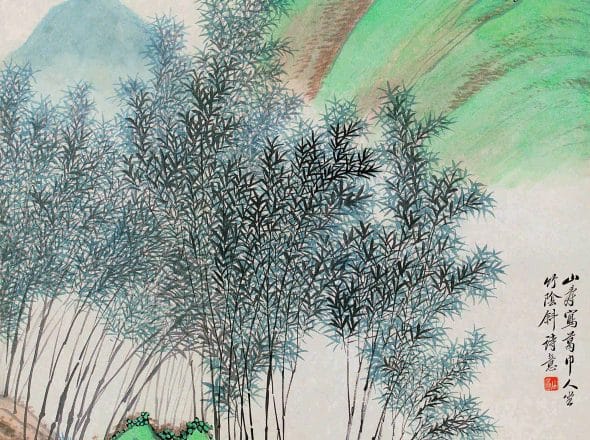
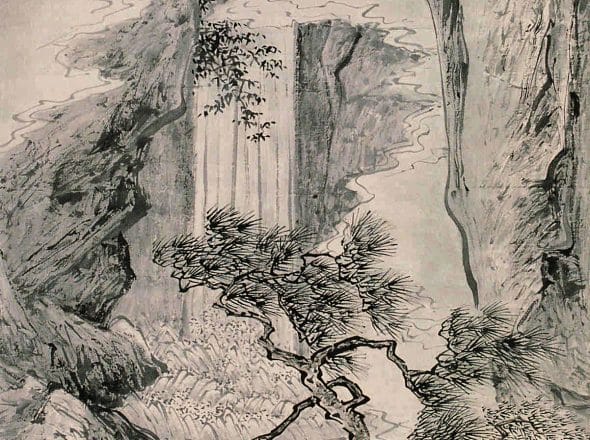
Zhu Angzhi, courtesy name Qingli, pseudonym Jinli, was from Wujin, Jiangsu, and later resided in Suzhou. His calligraphy and painting were deeply influenced by his family tradition, yet he surpassed his predecessors. His landscapes drew inspiration from Yun Shouping and Wang Hui, characterized by vigorous brushstrokes. In his middle age, his works exhibited a balance of brush and ink, capturing the essence of ancient masters. His flower, bamboo, and stone paintings were also clear and elegant. He studied Dong Qichang's calligraphy, excelling in running-cursive script, earning great acclaim in Jiangnan.
"Flying Waterfalls of Mount Lu"
This late work by Zhu Angzhi demonstrates his bold and free brushwork, exuding grandeur. It reflects his attempt to break free from the constraints of the orthodox "Six Masters of the Qing," reaching back to the styles of the Wu School and the Zhe School, though the brushwork sometimes conveys a sense of arrogance.
Zhu Angzhi (1764–1840)
Zhu Angzhi, courtesy name Qingli, pseudonym Jinli, was from Wujin, Jiangsu, and later resided in Suzhou. His calligraphy and painting were deeply influenced by his family tradition, yet he surpassed his predecessors. His landscapes drew inspiration from Yun Shouping and Wang Hui, characterized by vigorous brushstrokes. In his middle age, his works exhibited a balance of brush and ink, capturing the essence of ancient masters. His flower, bamboo, and stone paintings were also clear and elegant. He studied Dong Qichang's calligraphy, excelling in running-cursive script, earning great acclaim in Jiangnan.
"Flying Waterfalls of Mount Lu"
This late work by Zhu Angzhi demonstrates his bold and free brushwork, exuding grandeur. It reflects his attempt to break free from the constraints of the orthodox "Six Masters of the Qing," reaching back to the styles of the Wu School and the Zhe School, though the brushwork sometimes conveys a sense of arrogance.
Weng Tonghe (1830–1904)
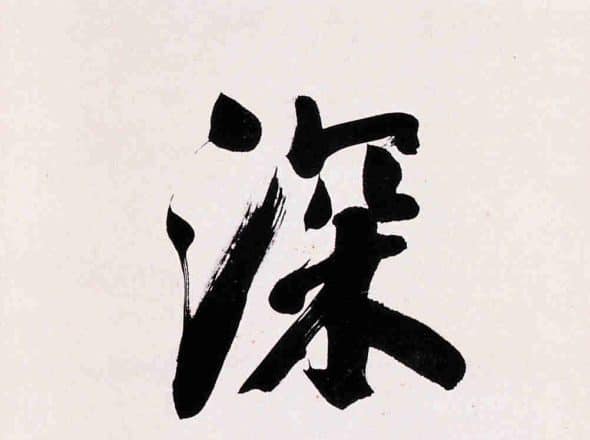
Weng Tonghe, courtesy name Shuping, and pseudonyms Songchan and Pinglu, among others, was the top scholar of the sixth year of Xianfeng (1856) and hailed from Changshu, Jiangsu. He served as tutor to emperors Tongzhi and Guangxu, advocated resistance against foreign powers, recommended Kang Youwei, and supported the Reform Movement, making him a significant political figure in modern Chinese history. After his death, he was posthumously honored with the title "Wengong."
Weng Tonghe's scholarly pursuits spanned the Han and Song dynasties, with his literary work grounded in the Tongcheng School and poetry influenced by the Jiangxi School. He occasionally painted but was particularly renowned for his calligraphy, being one of the giants of late Qing calligraphy. His calligraphy followed Yan Zhenqing's robust style, combined with the influences of Su Dongpo, Mi Fu, and Northern Wei steles, with a rhythmical blend of elegance and sturdiness. This couplet, composed in his unique style, incorporates characters from Mi Fu's "Shu Su Tie," executed with powerful and cohesive brushwork, making it a rare masterpiece.
Translation of couplet:
"Lowering the fishing rod into the deep ravine; The crane soars, presenting a clear and graceful posture."
Li Jiafu (1839–1894)
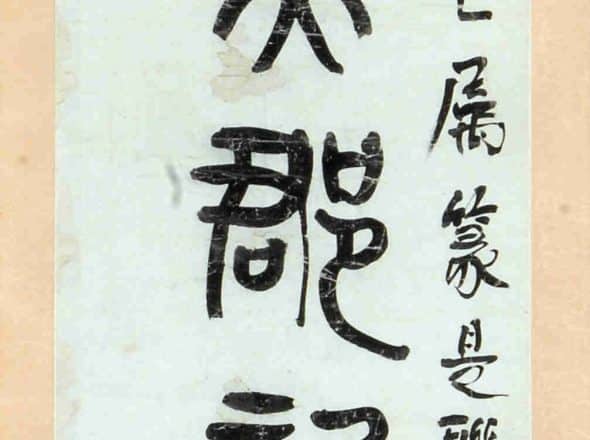
Li Jiafu, courtesy names Shengyu and Shengyu, and also known as Beixi, with alternative pseudonyms Luping, Shifuo Anzhu, Yuxi Laomin, and Xiao Zunzhe, was from Shimen (present-day Tongxiang), Zhejiang. An expert in appraisal and a prolific collector, he excelled in poetry, prose, calligraphy, and painting. He studied calligraphy under He Shaoji, particularly mastering seal and clerical scripts, and was a skilled seal carver. His landscapes, following Dai Xi, were fresh and elegant. Li settled in Wuxian, becoming known as a respected elder.
"Seven Character Couplet in Seal Script" (1870)
Though Li Jiafu studied under He Shaoji, he maintained his own direction in seal script creation, expressing ancient elegance through precise and refined brushwork, differing from He's vigorous style. This couplet, created in the ninth year of Tongzhi (1870), showcases his fine and graceful brushstrokes, with square and upright characters exuding a serene and refined charm.
Translation of couplet:
"A new book of poems from Wu County in my sleeve; Old wine stains from Hangzhou on my collar."
Shen Zongjing (1669–1735)
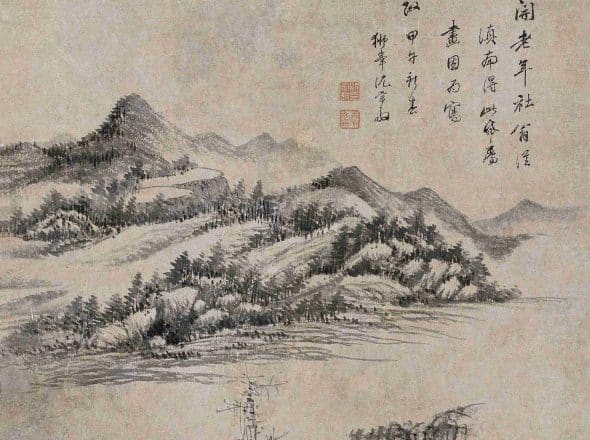
Shen Zongjing, courtesy names Nanji and Keting, and pseudonyms Shifeng, Shifeng Daoren, and Woxu Shanren, was the son of the famous calligrapher Shen Quan. He hailed from Huating (present-day Shanghai). He excelled in poetry, literature, painting, and music, with a particular talent for landscape painting. He served as Minister of the Imperial Stud.
"Ancient Tree in Empty Mountain"
This painting's composition draws inspiration from Ni Zan's "One River Two Banks" style, with brushwork influenced by Huang Gongwang, achieving an ancient and plain elegance. The paper used was a gift from the recipient, made of Dian Nan bark paper, which differs from Shen's usual semi-mature Xuan paper. This difference imparts a unique rustic charm to the painting. The inscription at the upper right reads: "This paper was obtained from Dian Nan by Mr. Kai of the Old Men's Society, who asked me to paint on it as an expression of his feelings. New Spring of the Jiawu year, by Shifeng Shen Zongjing." The seals read "Shen Zongjing Yin" and "Nanji Shi," with the collector's seal "Xian Zeng Zhen Wan" at the lower right.