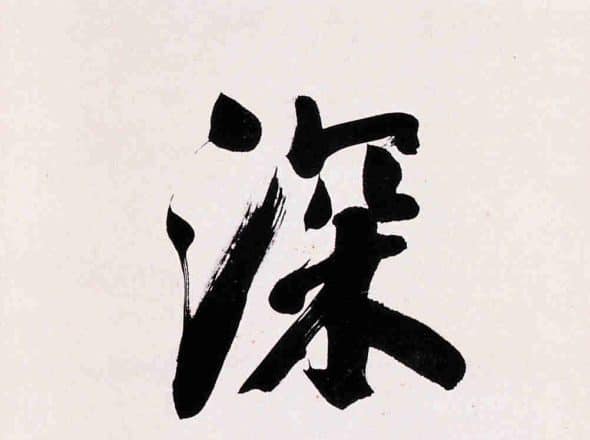
Weng Tonghe (1830–1904)
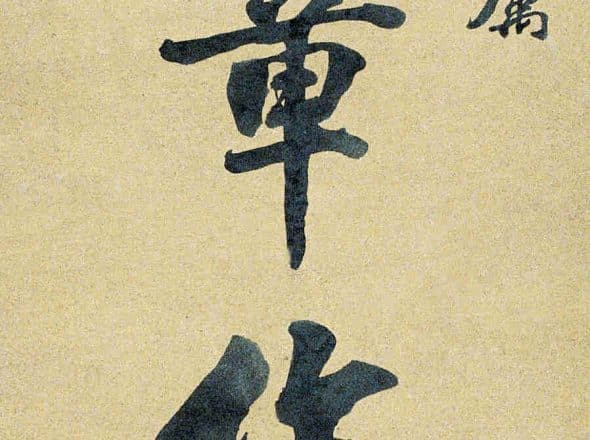
Weng Tonghe, courtesy name Shuping, and pseudonyms Songchan and Pinglu, among others, was the top scholar of the sixth year of Xianfeng (1856) and hailed from Changshu, Jiangsu. He served as tutor to emperors Tongzhi and Guangxu, advocated resistance against foreign powers, recommended Kang Youwei, and supported the Reform Movement, making him a significant political figure in modern Chinese history. After his death, he was posthumously honored with the title "Wengong."
Weng Tonghe's scholarly pursuits spanned the Han and Song dynasties, with his literary work grounded in the Tongcheng School and poetry influenced by the Jiangxi School. He occasionally painted but was particularly renowned for his calligraphy, being one of the giants of late Qing calligraphy. His calligraphy followed Yan Zhenqing's robust style, combined with the influences of Su Dongpo, Mi Fu, and Northern Wei steles, with a rhythmical blend of elegance and sturdiness. This couplet, composed in his unique style, incorporates characters from Mi Fu's "Shu Su Tie," executed with powerful and cohesive brushwork, making it a rare masterpiece.
Translation of couplet:
"Lowering the fishing rod into the deep ravine; The crane soars, presenting a clear and graceful posture."
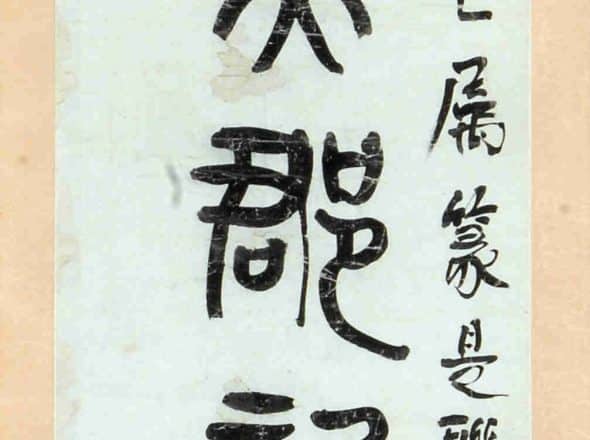
Li Jiafu (1839–1894)
Li Jiafu, courtesy names Shengyu and Shengyu, and also known as Beixi, with alternative pseudonyms Luping, Shifuo Anzhu, Yuxi Laomin, and Xiao Zunzhe, was from Shimen (present-day Tongxiang), Zhejiang. An expert in appraisal and a prolific collector, he excelled in poetry, prose, calligraphy, and painting. He studied calligraphy under He Shaoji, particularly mastering seal and clerical scripts, and was a skilled seal carver. His landscapes, following Dai Xi, were fresh and elegant. Li settled in Wuxian, becoming known as a respected elder.
"Seven Character Couplet in Seal Script" (1870)
Though Li Jiafu studied under He Shaoji, he maintained his own direction in seal script creation, expressing ancient elegance through precise and refined brushwork, differing from He's vigorous style. This couplet, created in the ninth year of Tongzhi (1870), showcases his fine and graceful brushstrokes, with square and upright characters exuding a serene and refined charm.
Translation of couplet:
"A new book of poems from Wu County in my sleeve; Old wine stains from Hangzhou on my collar."
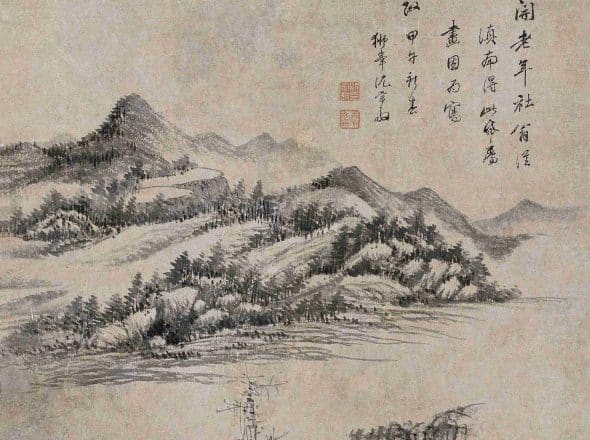
Shen Zongjing (1669–1735)
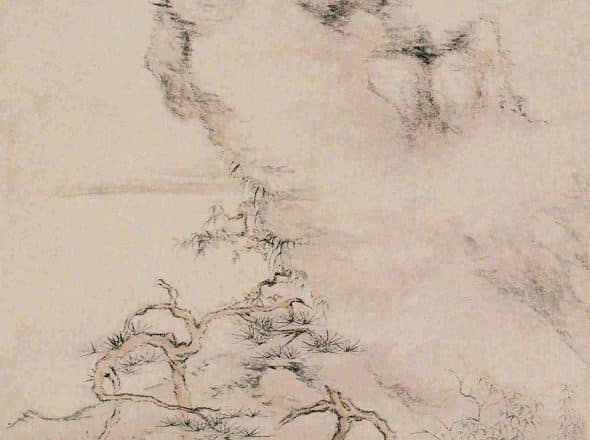
Shen Zongjing, courtesy names Nanji and Keting, and pseudonyms Shifeng, Shifeng Daoren, and Woxu Shanren, was the son of the famous calligrapher Shen Quan. He hailed from Huating (present-day Shanghai). He excelled in poetry, literature, painting, and music, with a particular talent for landscape painting. He served as Minister of the Imperial Stud.
"Ancient Tree in Empty Mountain"
This painting's composition draws inspiration from Ni Zan's "One River Two Banks" style, with brushwork influenced by Huang Gongwang, achieving an ancient and plain elegance. The paper used was a gift from the recipient, made of Dian Nan bark paper, which differs from Shen's usual semi-mature Xuan paper. This difference imparts a unique rustic charm to the painting. The inscription at the upper right reads: "This paper was obtained from Dian Nan by Mr. Kai of the Old Men's Society, who asked me to paint on it as an expression of his feelings. New Spring of the Jiawu year, by Shifeng Shen Zongjing." The seals read "Shen Zongjing Yin" and "Nanji Shi," with the collector's seal "Xian Zeng Zhen Wan" at the lower right.
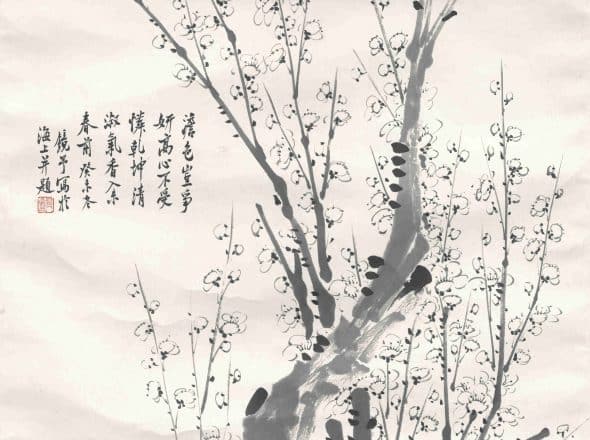
Tang Yifen (1778–1853)
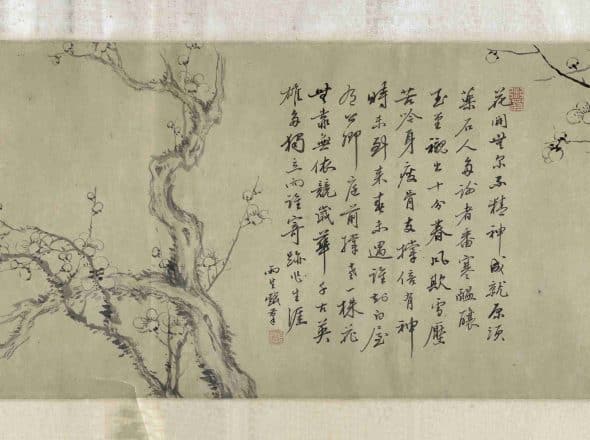
Tang Yifen, courtesy names Yusheng and Ruoyi, and pseudonyms Zhou Weng and Qinyin Daoren, was from Wujin (present-day Changzhou), Jiangsu. The Tang family was a prominent clan in Changzhou, and Tang Yifen, benefiting from his family's status, inherited the title of Yunqi Commander at the age of sixteen. He held various military positions, eventually rising to Deputy General of Wenzhou. Due to illness, he retired and settled in Nanjing, where he built the Qinyin Garden. Tang Yifen was a man of diverse interests and exceptional talent, excelling in astronomy, geography, and the teachings of the ancient philosophers. He was proficient in poetry, calligraphy, and painting, and also had a keen interest in music, horsemanship, and fencing. Among his many talents, he was particularly renowned for his painting. In 1853, during the Taiping Rebellion's attack on Nanjing, Tang Yifen assisted the Governor of Liangjiang, Lu Jianying, in defending the city. Following their defeat, he calmly composed a final poem and drowned himself, earning the posthumous title "Zhenmin."
"Ink Plum Blossom"
This scroll of ink plum blossoms follows the brushwork of Yuan dynasty artist Wang Mian and Qing dynasty artist Jin Nong, characterized by its delicate elegance, slender and graceful branches, and a sense of sparse shadows and cold fragrance. The brushstrokes are relaxed and free, capturing the essence of literati painting.
Wang Xun (1846–1915)
Wang Xun, originally named Xuehan, courtesy name Ziyuan, and also known as Yuanyuo, was from Wujin (present-day Changzhou), Jiangsu. In the 18th year of Guangxu (1892), he passed the imperial examination and was appointed as a compiler at the Hanlin Academy. He was skilled in poetry and prose. In his later years, he moved to Shanghai, where he founded the first organized art society in modern times, the Haishang Tijin Guan Jinshi Calligraphy and Painting Society, and served as its president.
Wang Xun excelled in seal script, clerical script, running script, and regular script. His running script and regular script followed the styles of Yan Zhenqing, capturing his spirit and essence, and were further enriched by the Wei stele style. His works were neat and grand, making them suitable for shop signs, which were very popular in Shanghai at the time. Together with his fellow townsman Tang Tuo, Wang Xun wrote many of Shanghai's shop signs, earning a substantial income. As a "professional calligrapher," his works often displayed a consistent style, as seen in this couplet.
Translation of couplet:
"The Milky Way serves as a chapter, granting longevity to people; The celestial path invites, bringing fame and honor to the world."
Tang Yifen (1778–1853)
Tang Yifen, courtesy names Yusheng and Ruoyi, and pseudonyms Zhou Weng and Qinyin Daoren, was from Wujin (present-day Changzhou), Jiangsu. The Tang family was a prominent clan in Changzhou, and Tang Yifen, benefiting from his family's status, inherited the title of Yunqi Commander at the age of sixteen. He held various military positions, eventually rising to Deputy General of Wenzhou. Due to illness, he retired and settled in Nanjing, where he built the Qinyin Garden. Tang Yifen was a man of diverse interests and exceptional talent, excelling in astronomy, geography, and the teachings of the ancient philosophers. He was proficient in poetry, calligraphy, and painting, and also had a keen interest in music, horsemanship, and fencing. Among his many talents, he was particularly renowned for his painting. In 1853, during the Taiping Rebellion's attack on Nanjing, Tang Yifen assisted the Governor of Liangjiang, Lu Jianying, in defending the city. Following their defeat, he calmly composed a final poem and drowned himself, earning the posthumous title "Zhenmin."
"Ink Plum Blossom"
This scroll of ink plum blossoms follows the brushwork of Yuan dynasty artist Wang Mian and Qing dynasty artist Jin Nong, characterized by its delicate elegance, slender and graceful branches, and a sense of sparse shadows and cold fragrance. The brushstrokes are relaxed and free, capturing the essence of literati painting.
Liang Tongshu, courtesy name Yuanying, pseudonym Shanzhou, later known as Bu Weng, and after ninety, Xinwu Changweng, with the studio name Pinluo'an, was from Qiantang (present-day Hangzhou), Zhejiang. The son of Grand Secretary Liang Shizheng, he was naturally gifted and composed, passing the imperial examination in 1752. Liang was proficient in regular and running script calligraphy, initially studying Yan Zhenqing and Liu Gongquan, later adopting the styles of Mi Fu and the Tang dynasty manuscript calligraphy, ultimately forming his unique style. Alongside Liu Yong, Weng Fanggang, and Wang Wenzhi, he was one of the "Four Masters of the Stele School" in the Qing dynasty and was also known as one of the "Three Liangs" along with Liang Yusheng and Liang Guozhi.
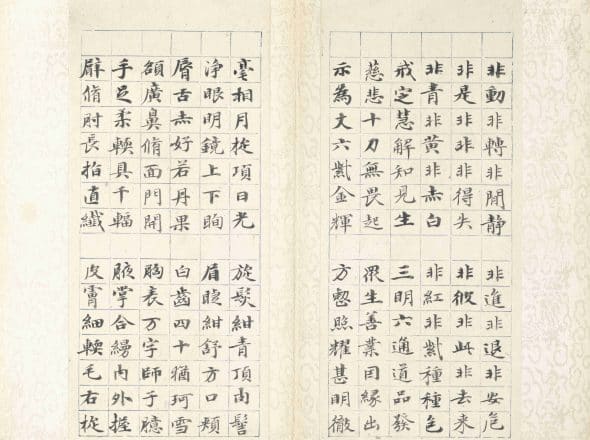
"Regular Script Manuscript of Buddhist Text in Eighteen Leaves" (1799)
Liang Tongshu's skill in small regular script was profound, and even in his old age, he wielded the brush with ease, never delegating his work to others. He enjoyed studying Zen and Buddhist scriptures, copying numerous Buddhist texts. This "Regular Script Manuscript of Buddhist Text in Eighteen Leaves" was written for his grandnephew Xingzi at the age of seventy-seven. The manuscript consists of eighteen leaves, with the first eight containing the "Vimalakirti Sutra" and the latter ten the "Immeasurable Meanings Sutra." The inscription reads: "This manuscript of two sutras, over three thousand characters, was completed in five days. Disturbed by worldly matters, I could not write it in one go. My hand grows weaker daily, yet it still shows no signs of deterioration. I am privately pleased, fearing I may never be able to do this again. Xingzi should treasure it well. Written on the 21st day of the eighth month in the fourth year of Jiaqing (1799), by Shanzhou, aged seventy-seven." The seal reads "Mizhong Beiren." This work is included in the "Collected Writings of Pinluo'an," although the recorded colophon lacks the date. The small regular script is fluid, blending the styles of Yan, Liu, and Zhao, with a touch of Dong Qichang's light ink, reminiscent of Tang dynasty manuscript calligraphy. The brushwork is not monotonous or rigid but orderly and varied, combining formality with a natural ease. The colophon reveals Liang Tongshu's high standards for his work, and he was quite satisfied with this piece.
Tang Yifen (1778–1853)
Tang Yifen, courtesy names Yusheng and Ruoyi, and pseudonyms Zhou Weng and Qinyin Daoren, was from Wujin (present-day Changzhou), Jiangsu. The Tang family was a prominent clan in Changzhou, and Tang Yifen, benefiting from his family's status, inherited the title of Yunqi Commander at the age of sixteen. He held various military positions, eventually rising to Deputy General of Wenzhou. Due to illness, he retired and settled in Nanjing, where he built the Qinyin Garden. Tang Yifen was a man of diverse interests and exceptional talent, excelling in astronomy, geography, and the teachings of the ancient philosophers. He was proficient in poetry, calligraphy, and painting, and also had a keen interest in music, horsemanship, and fencing. Among his many talents, he was particularly renowned for his painting. In 1853, during the Taiping Rebellion's attack on Nanjing, Tang Yifen assisted the Governor of Liangjiang, Lu Jianying, in defending the city. Following their defeat, he calmly composed a final poem and drowned himself, earning the posthumous title ""Zhenmin.""
""Iron Flute Tower"" (1813)
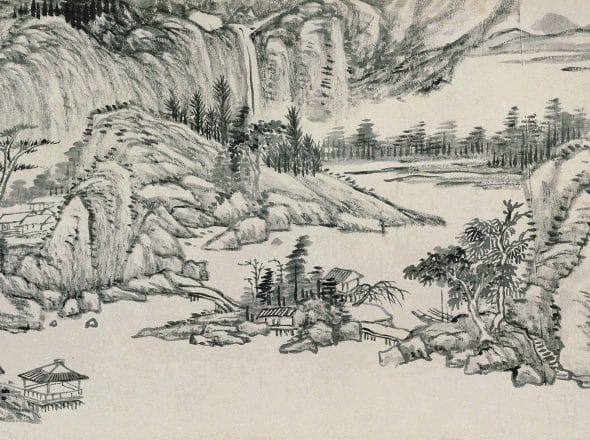
This painting was created during the Jiaxing Renshen Sacrifice Day (1813 in the Gregorian calendar) when Tang Yifen was serving as the Commandant of Qichang in Guangdong, at the age of thirty-seven. The painting bears the horizontal inscription ""Iron Flute Tower"" in clerical script, and below it, a long colophon in running-cursive script. The colophon recounts how Lu Feng's third brother in Beijing obtained an ancient iron flute of unknown origin, treasured for its resonant sound. He wished to name a tower after it and asked Tang Yifen to create this painting, followed by a long poem in the gehang style. The full content is recorded in volume seven of the ""Qinyin Garden Collection"" under the title ""Iron Flute Song for Commandant Luo Lufeng (Jiang),"" indicating that the recipient of the painting was Commandant Luo Jiang. The two texts have minor differences, suggesting later revisions in the published collection. The painting features fine and dry brushstrokes with light ink evenly applied, achieving a simple yet profound artistic effect. It is considered one of Tang Yifen's early masterpieces using the dry brush technique.
Bi Han (1732–1807)
Bi Han, courtesy name Youhan, and pseudonyms Jiaolu and Zhi'an Daoren, was from Yanghu (present-day Changzhou), Jiangsu. He excelled in landscape painting, adhering to ancient techniques while also learning from Yun Shouping and Wang Yuanqi, and was renowned for his dual excellence in painting and calligraphy. The Qing critic Wang Xuehao praised him, saying, "Recent paintings are either constrained by rules or overly free, both from not knowing ancient methods. Jiaolu's natural talent and skill surpass contemporary trends, truly surpassing current practices," showing immense admiration.
"Landscape Scroll"
This landscape scroll depicts the scenery of Jiangnan, with the artist's fluid brushwork using dry ink for texture strokes and light shading, achieving an artistic effect of richness and clarity. From the inscriptions, it is known that Bi Han created this work after seeing Qian Weicheng's long landscape scroll, following its general style. More than a decade later, at the age of seventy-four, he revisited and refined the painting, advising the owner to "preserve it well," marking it as a cherished creation. The seamless integration of the two phases of painting is evident, and the scroll contains numerous inscriptions by notable figures, adding to its value.
Liang Qichao (1873–1929)
Liang Qichao, courtesy name Zhuoru and Renfu, and pseudonym Rengong and Master of the Ice Room, was from Xinhui, Guangdong. In his youth, he, along with his teacher Kang Youwei, advocated for reforms and was one of the leaders of the Reform Movement, known collectively as "Kang Liang." After the Xinhai Revolution, he briefly joined Yuan Shikai's government, serving as Minister of Justice. He later criticized Yuan Shikai's attempt to become emperor and Zhang Xun's restoration efforts. Liang joined Duan Qirui's government and supported the May Fourth New Culture Movement. He was a prolific scholar, contributing to philosophy, literature, history, classical studies, law, ethics, and religion, with his works compiled in the "Collected Works of the Ice Room."
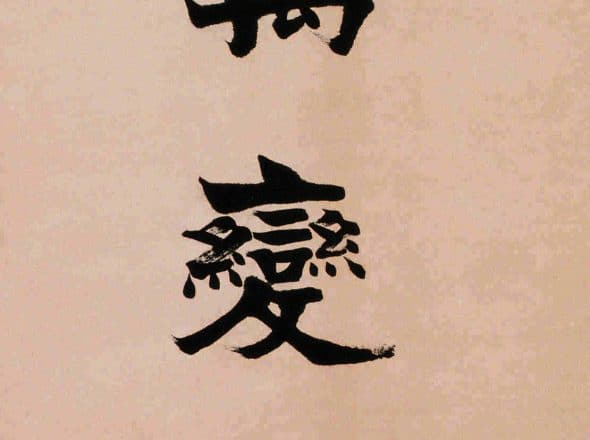
"Seven Character Couplet in Regular Script"
Liang Qichao's early calligraphy studies were influenced by Ouyang Xun, later studying under Kang Youwei, following his teacher's Beixue theory, focusing on Han, Wei, and Six Dynasties inscriptions. He particularly admired the "Stele of Zhang Qian" from the Han dynasty and the ""Stele of Zhang Menglong"" from the Northern Wei dynasty, balancing their angled structures with even strokes to achieve a harmonious flow. This regular script couplet exemplifies his typical Wei stele style, with steady, confident brushstrokes, balanced square and round forms, and clear distinctions between light and heavy strokes, merging the solidity of stone inscriptions with the elegance of literary forms.
Wu Hong (c. 1610–c. 1690)
Wu Hong, courtesy name Yuandu, and pseudonym Zhushi, was originally from Jinxian, Jiangxi, but later settled in Nanjing. His home in Yunlin Mountain, near the ancestral home of Zhou Lianggong in Jinxian, contributed to his cultural immersion. Known for his bold personality and eloquence, Wu Hong excelled in painting landscapes, ink bamboo, figures, and poetry. As one of the "Eight Masters of Jinling," his landscapes followed Song and Yuan traditions, with bold and free brushstrokes. He often used chaotic brush and axe-cut strokes for rocks and strong brushstrokes for trees, making him the most uninhibited among the Jinling School painters.
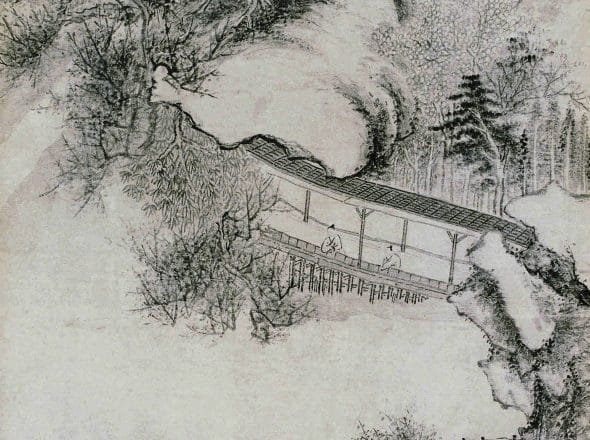
"Imitating Yuan Dynasty Landscape"
This painting's composition alternates between dense and sparse areas, creating a unique scene. Jagged rocks rise from the lower right corner, connected by a straight corridor. A thatched cottage and courtyard are half-hidden in the forest, with cliffs and trees hanging behind. The distant background features a serene creek and sparse trees, blending harmoniously with the expansive water in the foreground and contrasting with the jagged rocks and trees. The painting's spatial rhythm, created by the varying perspectives and blank spaces, immerses the viewer. The rocks are rendered with different brushstrokes, including chaotic brush, small axe-cut, and hemp-fiber texture strokes, varying with distance. The lines have a fuzzy texture due to the paper medium, with slight smudging adding to the overall charm. The brush and ink exhibit the thickness and strength of Song artists and the elegance and clarity of Yuan artists, making this paper work more profound than his silk paintings. The inscription reads: "Song-style brush techniques taught by Master Muweng. Two days before the Double Ninth Festival in the year Renzi (1692), by Wu Hong of Jinxian." The seals include "Seal of Wu Hong" in white and "Yuandu" in red.
Yun Bing (dates unknown)
Yun Bing, active during the Yongzheng and Qianlong periods, courtesy name Qingyu, pseudonym Haoru, and alternative pseudonym Lanling Nushi, was from Wujin (present-day Changzhou), Jiangsu. She was the second daughter of the scholar Yun Zhonglong and the great-granddaughter of Yun Nantian. Growing up in an artistic family, she began painting from a young age. By the age of thirteen, she could paint flowers and birds using the ""boneless"" technique, effectively inheriting the Yun family style.
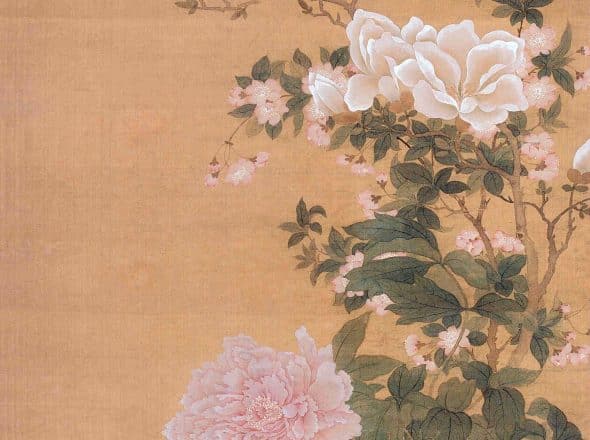
"Wealth and Honor of the Jade Hall"
Yun Bing's ""boneless"" meticulous paintings are characterized by their elegance and finesse, particularly excelling in the use of powder. The paintings are exquisitely beautiful, showcasing the utmost in graceful charm. Early in the Qianlong reign, the Governor of the Two Jiang Provinces presented Yun Bing's painting to the Empress Dowager, and the Qianlong Emperor praised it in verse, bringing her instant fame. For a female painter to receive such honors was very rare, indicating Yun Bing's high level of skill and reflecting the acceptance of the Nantian painting style at the time. This painting features white magnolias and pink peonies, with full, rich blooms exuding luxury and elegance. The flowers, branches, and leaves all sway gracefully. The brushwork is delicate and beautiful, the colors are bright and elegant, and the use of powder is superb, making the flowers appear to shimmer in the sunlight. This work is a representative masterpiece by Yun Bing. The inscription reads: "Inspired by Northern Song artist Xu Chongsi's coloring, Lanling Woman Yun Bing." The seals include "Seal of Yun Bing Nushi" in white and "Qingyu" in red.