Wang Yuanqi (1642–1715)
Wang Yuanqi, courtesy name Maojing, and pseudonym Lutai, also known as Shi Shidaoren, was from Taicang, Jiangsu. He achieved the jinshi degree in the ninth year of Kangxi (1670) and was summoned to serve in the court for his dedication to painting. Wang Yuanqi was entrusted with compiling the ""Peiwenzhai Calligraphy and Painting Manual"" and rose to the position of Assistant Minister of the Ministry of Revenue. Wang Yuanqi received direct guidance from his grandfather Wang Shimin and dedicated himself to landscape painting, following the styles of Dong Qichang and his grandfather. Favored by the Kangxi Emperor, he led the artistic community, forming the ""Loudong School."" Along with Wang Shimin, Wang Jian, Wang Hui, Wu Li, and Yun Shouping, he was among the ""Six Masters of the Qing Dynasty,"" representing the orthodox lineage of Qing dynasty landscape painting.
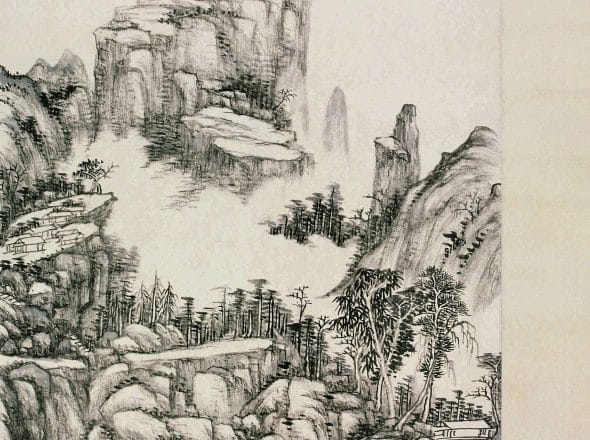
""Solitary Mountain"" (1698)
Wang Yuanqi excelled in landscape painting, following his family's tradition and drawing inspiration from Huang Gongwang. He favored dry brush and scorched ink, layering texture strokes with a steady hand, claiming his brush had a ""diamond's edge."" This painting depicts the scenery of Little Lonely Mountain, situated in the Yangtze River in Anhui Province, known for its strategic and picturesque location, praised by many literati. The year Wuyin corresponds to the 37th year of Kangxi (1698), when Wang Yuanqi was 57 years old. The inscription indicates the painting was created before that year. This work showcases the typical style he established after the age of fifty, with rich and clear brush and ink charm, an abundant scholarly atmosphere, and a high degree of elegance. The upper right corner bears the inscription: ""While traveling on the river, I sketched Little Lonely Mountain, using the brush of Da Chi, during the winter of the year Wuyin (1698) and early winter of the year Gengchen, while in the capital, Lutai Qi."" The seals include ""Sweep Flower Temple,"" ""Seal of Wang Yuanqi,"" and ""Lutai."
"Hua Yan (1682–1756)
Hua Yan, courtesy name Qiuyue, and pseudonym Xinluo Shanren, was from Shanghang, Fujian. A renowned painter of the Yangzhou School, Hua Yan spent most of his life between Yangzhou and Hangzhou, making a living by selling his paintings. He excelled in painting, calligraphy, and poetry, earning the title of ""Three Perfections."" His most famous contributions to painting were his innovative small freehand bird-and-flower technique, along with the styles of Bada Shanren's large freehand ink paintings and Yun Shouping's ""boneless"" realistic style, forming the three major creative influences in Qing dynasty bird-and-flower painting, which significantly inspired late Qing and modern painting development.
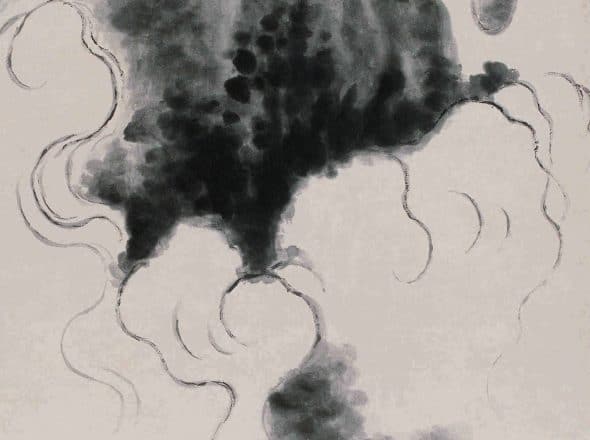
""Cloud Sea of Mount Tai""
This large freehand landscape painting by Hua Yan vividly depicts the mystical scenery of the cloud sea of Mount Tai. The near mountains are shrouded in mist, appearing ethereal and majestic, while the peaks loom beyond the clouds. The entire composition radiates an aura of dynamic tranquility, capturing the harmony of motion and stillness, showcasing Hua Yan's rich imagination and expressive power."
Jin Nong (1687–1763)
Jin Nong, courtesy names Shoumen, Sinong, and Jijin, and the pseudonym Dongxin, had many alternative names, including Jiliu Shanmin, Qujiang Waishi, Ji Mei Zhu, Lotus Body Hermit, and Wealthy Farmer of the 120 Inkstones Field. He was from Qiantang (present-day Hangzhou) but lived in Yangzhou for a long time. Jin Nong was an expert in identifying inscriptions on ancient bronzes and stones, and he created his unique "lacquer script." He began painting formally after the age of fifty, excelling in plum blossoms, bamboo, figures, and landscapes, with a distinctive, unrefined style, making him a representative painter of the Yangzhou School.
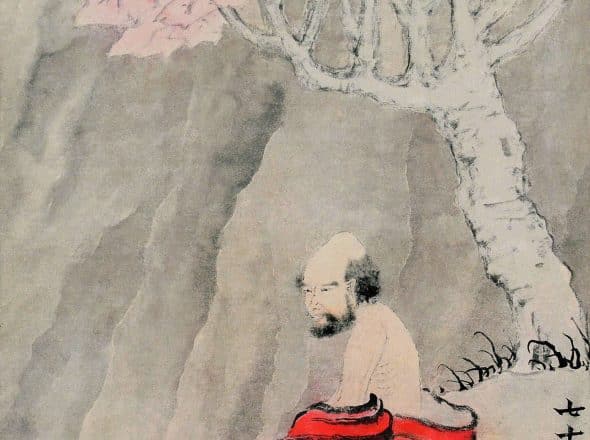
"Dharma" (1762)
This painting by Jin Nong, created at the age of 76, is one of his late works, produced a year before his death. The composition is harmonious and serene, with a detailed portrayal of the Dharma figure, particularly the expressive eyes. The vivid red robe contrasts sharply with the subdued background, enhancing the overall impact. Jin Nong used bold outlines for the figure, with thick, substantial brushstrokes, and softer shading for the background, creating layers of contrast. The painting exudes a transcendent and serene atmosphere, capturing the essence of Dharma's spirit. The red robe technique originated from Zhao Mengfu and was widely adopted in the late Qing and Republican periods, especially by Zhang Daqian. The inscription reads: "Painted by the 76-year-old Jin Nong." Below the inscription is the seal "Jin Shi Shoumen." The lower right corner bears the red collection seal "Collected by Zhang Yunzhong of Shanyin."
Huang Shanshou (1855–1919)
Huang Shanshou, originally named Yao, was known by the courtesy names Xuchu and Xuchu and the pseudonyms Lisheng, Xudaoren, and Hexi Waishi. Born in Wujin, Jiangsu (modern-day Changzhou), Huang came from a humble background but demonstrated remarkable artistic talent from a young age. By his early teens, he was already skilled in painting. Renowned for his versatility, he excelled in landscapes, flowers and birds, and figure painting. Early in his career, he worked as a guest artist, and later, after the Xinchou year, he gained international recognition, selling his works overseas and becoming a prominent figure in Shanghai's art scene.
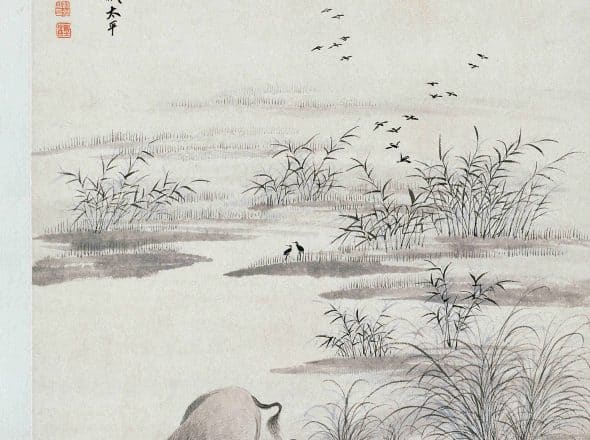
"Dragon Appearing in the Clouds"
This scroll showcases Huang Shanshou's exceptional skill in depicting ink dragons, a subject he mastered through both rigorous study and direct observation of nature. Inspired by Mi Zhun of Changzhou and informed by his practice of studying natural forms like clouds and mist at dawn, Huang developed a unique style that combined technical precision with dynamic expression.
Sha Fu (1831–1906)
Sha Fu, courtesy name Shanchun, also known as Sanchun and Su An, with an alternative pseudonym Xiangjing Waishi, was from Wuxian (present-day Suzhou), Jiangsu. Born into a family of painters, he studied under Wumen painter Ma Xiangen. Sha Fu excelled in figure painting, inspired by Chen Hongshou and Ren Xiong, creating lively and expressive works. He was particularly skilled in painting the faces of ladies, earning the nickname "Sha's Faces." He also painted flowers with elegant and subtle tones, rich in vitality, and his landscapes were sparse and charming.
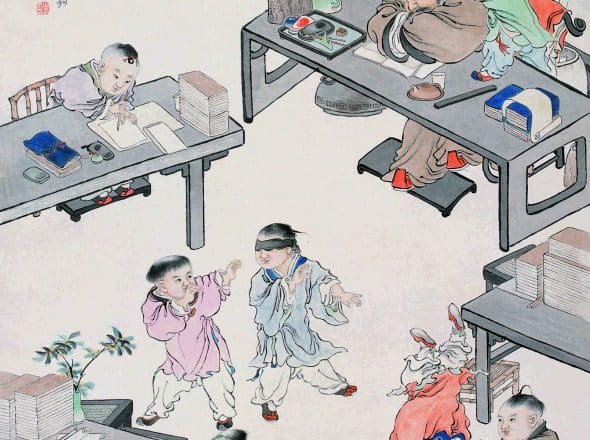
"Children Playing in the Library"
This painting depicts a lively scene of children playing in a library while their tutor sleeps, except for one child diligently writing in the upper left. The inscription clarifies the theme, praising the hardworking child, who would later become "Wenzheng Gong" (referring to Fan Zhongyan). The painting aims to offer moral instruction rather than simply portraying the joy of children in a classroom. The colors are bright and elegant, with meticulous brushwork capturing the mischievous and lively expressions of the children.
"Qian Weicheng (1720–1772)
Qian Weicheng, originally named Xinlai, courtesy name Zongpan, and later Jiahui and Chashan, was from Wujin (present-day Changzhou), Jiangsu. He was a top scholar in the tenth year of Qianlong (1745) and served in the Southern Study, becoming a close aide to the emperor. Renowned for his poetry, calligraphy, and painting, his style catered to the emperor's taste, establishing him as an ""official painter."" As an official, he served in high positions, fulfilling his duties excellently. Qian Weicheng passed away at home while mourning his father in the 37th year of Qianlong (1772), aged 53, and was posthumously honored with the title ""Wenmin,"" a rare distinction shared by masters Zhao Mengfu and Dong Qichang.
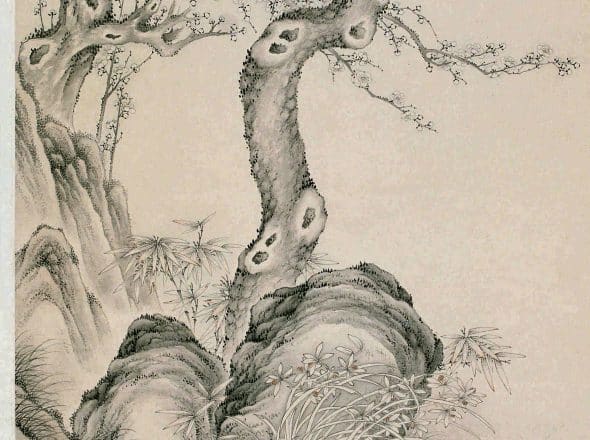
""Pine, Plum, and Immortals""
This painting is executed with fine brushwork, inscribed in small regular script ""Respectfully painted by Qian Weicheng, the subject."" The painting combines pine, plum, daffodil, orchid, lingzhi mushroom, and bamboo in a lively and elegant arrangement, exuding an ethereal and refined air. The composition is dignified and dynamic, with delicate and elegant colors, reflecting the courtly aesthetics merged with literati taste. These plants symbolize longevity, integrity, and auspiciousness, making them common themes in Chinese painting. The upper right corner bears the imperial seal ""Qianlong Yulan Zhi Bao,"" confirming it was painted for Emperor Qianlong and was once part of the Qing imperial collection.
"
Qian Qiu (dates unknown)
Qian Qiu, courtesy name Shiting, was active during the Qianlong and Jiaqing periods. He was from Rugao, Jiangsu. Qian Qiu was skilled in landscapes, flowers, birds, and figures, finding a unique path amidst the dominant "Four Wangs, Wu, and Yun" styles. He followed the styles of Shen Zhou and Wen Zhengming of the Wu School, earning considerable fame.
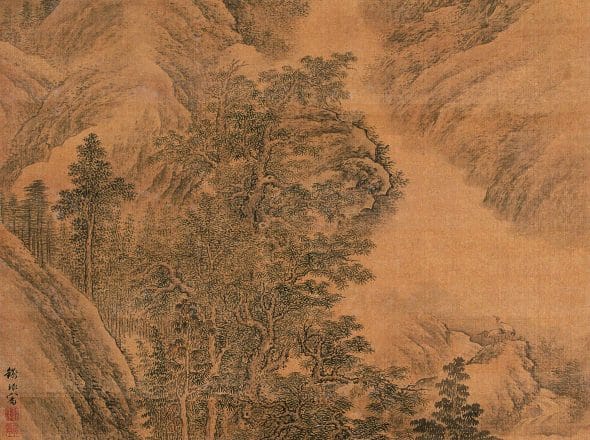
"Mountain Pavilion and Cloud Peaks"
This painting is rendered entirely with meticulous ink on silk. The rocks are depicted with hemp-fiber texture strokes, combining ink washes and contours with a balance of strength and softness, avoiding harsh and jagged lines. Merging elements from the Song, Yuan, and Wu School traditions, it diverges from the prevailing "Four Wangs" orthodox style, showcasing a distinctive personal approach.
Zheng Dai (dates unknown)
Zheng Dai, courtesy name Zaodong, pseudonyms Danquan and Ruishi Shiren, was from Qiantang (present-day Hangzhou), Zhejiang. He was a close friend of Hua Yan in poetry and painting. Art critics praised Hua Yan for his exceptional style and Zheng Dai for his skill. Zheng Dai excelled in painting ladies and flowers, with particularly strong skills in landscapes.
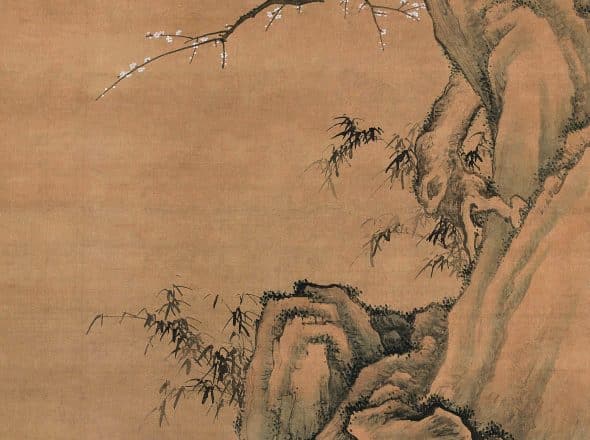
"Plum Blossoms and Scholar"
This painting features a concise composition, with axe-cut strokes depicting rocks that are powerful and vigorous. An old plum tree with gnarled branches and blooming flowers rendered in lead white appears crystalline and delicate, resembling stars. The ink bamboo is also elegant and refined. In the lower left, a scholar reclines leisurely against a rock, his demeanor natural and lifelike. The inscription reads: "At the end of winter in the year of Jiwei, painted by Ruishi Shiren Zheng Dai," with two seals in red and white, "Zheng Dai" and "Zaodong."
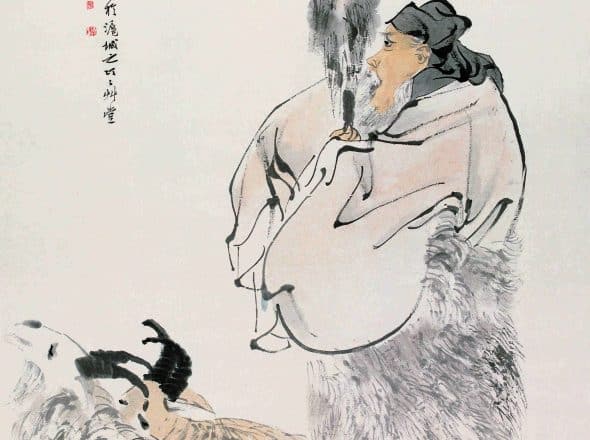
Ren Yi (1840–1896)
Ren Yi, courtesy name Bonian, was from Shanyin (present-day Shaoxing), Zhejiang. His father, Hesheng, was skilled in portrait painting and taught Ren Yi from a young age. Later, Ren Yi became a disciple of Ren Xiong and studied under Ren Xun. He excelled in painting figures, flowers, birds, animals, and landscapes. Ren Yi blended ancient and contemporary styles with a focus on realism, creating a new and lively style with vibrant colors and dynamic forms. He found a perfect balance between elegance and popular appeal, influencing many subsequent painters and becoming a great master of the Shanghai School of painting.
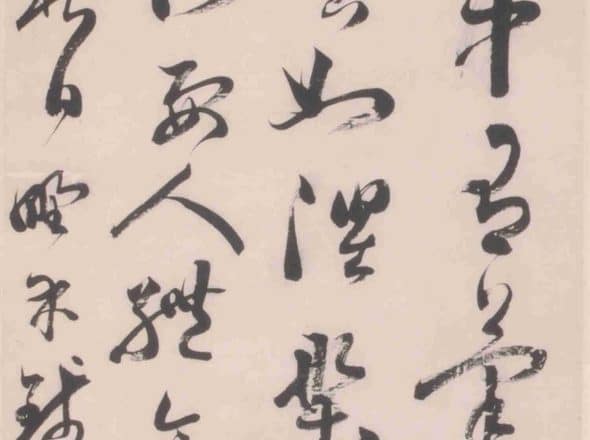
Qian Bokeng (1738–1812)
Qian Bokeng, courtesy name Lusi, was also known by his pseudonyms Yu Bei and Puxie Shanqiao. He was a student at the Imperial Academy and the nephew of Qian Weicheng, a top scholar and painter. Hailing from Yanghu (present-day Changzhou), Jiangsu, he was adept in calligraphy, following the styles of Dong Qichang and Huang Tingjian to emulate the works of Li Yong and Yan Zhenqing, gaining recognition in his time.
"Huang Tingjian's Calligraphy Discourse in Cursive Script"
This running script piece demonstrates fluid writing and a rigorous structure, transitioning seamlessly between strokes. It embodies the weightiness of Yan Zhenqing and the uniqueness of Huang Tingjian, marking it as an exceptional work from his later years.
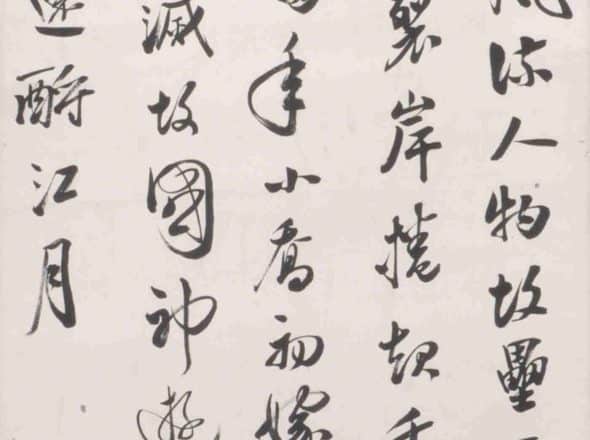
Sun Fuyuan (1894–1966)
Originally named Fuyuan, with the courtesy name Yangquan and pseudonyms such as Fulu, Baisheng, Tongbai, and Songnian, Sun Fuyuan was from Shaoxing, Zhejiang. He was a renowned essayist and journalist. In 1919, under the recommendation of Lu Xun, he entered Peking University, where he worked as a librarian and served as the secretary to Li Dazhao, actively participating in the May Fourth Movement. At the end of 1920, he co-founded the Literary Research Society with Mao Dun, Zheng Zhenduo, and others.
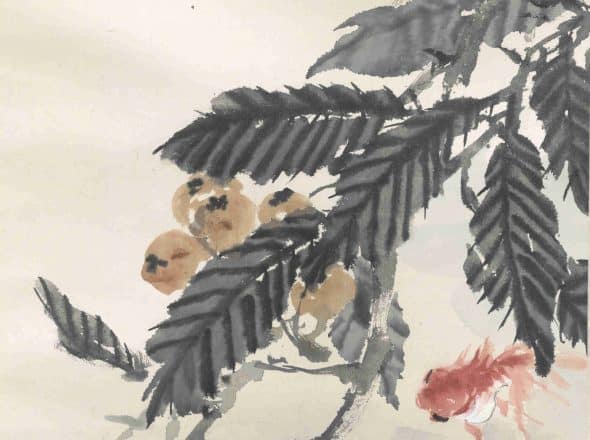
Wang Yachen (1894–1983)
Wang Yachen, a modern Chinese painter and art educator, hailed from Hangzhou, Zhejiang. He was known for his lively and vivid depictions of birds, flowers, and fish, with a particular reputation for painting goldfish. His works are celebrated both domestically and internationally for their elegance and vibrant colors.
Pan Boying (1900–1978)
Pan Boying was a Chinese music educator and painter from Jiangyin, Jiangsu. He was one of the founders of Shanghai Xinhua Academy of Fine Arts. Pan excelled in traditional Chinese painting, with a special fondness for portraying flowers and insects. He authored "Kaiming Music Tutorial."